Why sending more emails won't improve member engagement
When member engagement dips, email is usually the first lever marketing teams reach for. The reasoning is intuitive: if the last campaign underperformed, perhaps the next one will compensate. Send a follow-up. Add a reminder sequence. Increase cadence going into renewal season. It feels proactive, and in a situation that's otherwise hard to control, that sense of momentum matters.
The problem is that volume and relevance are not the same thing. For most associations, declining email engagement is not a signal to send more. It's a signal that something more fundamental needs to change about who receives what, when, and why.
The volume trap
There's a ceiling effect in email marketing that most membership professionals encounter eventually, even if they don't immediately recognize it for what it is. Early in a contact list's lifecycle, increased frequency often does help: there are lapsed members who needed a nudge, prospective joiners who hadn't been asked clearly enough, or segments who weren't aware of a particular benefit or event. More communication can unlock that latent engagement.
But the effect doesn't scale indefinitely. Once a contact has had repeated opportunities to engage and hasn't, sending them more of the same content is unlikely to change their behavior. What it will do is gradually erode your deliverability as unsubscribes accumulate and open rates fall — signals to inbox providers that your messages are unwanted, making it harder to reach the people who actually want to hear from you.
Even among engaged contacts, there's a threshold. In a world where the average office worker receives well over a hundred emails a day, association communications are competing with everything else. The organizations that cut through are not the ones sending the most messages. They're the ones sending messages that feel timely, relevant, and worth opening in that moment.
What engagement actually looks like, and what predicts renewal
The more useful question is not "how often should we email?" but "what does genuine engagement look like for our members, and are we measuring it accurately?"
Open and click rates are the most commonly cited metrics, but they have real limitations as a proxy for actual engagement. Security software used by many organizations — particularly those in corporate, public sector, or financial services settings — automatically opens emails and follows links to scan for threats. This inflates open and click data in ways that can make a campaign look far more successful than it was. Some associations have seen open rates of 30% or higher on campaigns that generated almost no bookings, registrations, or replies. The discrepancy only makes sense once bot activity is factored in, and for associations with large proportions of members in regulated sectors, this is a more significant problem than many realize.
The activities that correlate most strongly with renewal are different in character: event registrations, resource downloads, CPD log submissions, community posts, completed renewals. These require an active choice from the member. They indicate that someone is genuinely using and valuing their membership, and consistently, the data shows that members who engage actively with professional development, community features, or specialist content are significantly more likely to renew than those who receive emails but take no further action.
That matters for how campaigns are designed. If email exists to drive those higher-value behaviors, the targeting decisions should follow from that goal — which contacts are most likely to register, download, or engage based on what they've already done?
The case for engagement scoring
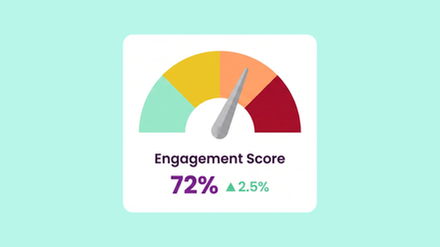
Engagement scoring is the practice of assigning weighted point values to member behaviors and maintaining a rolling score that reflects current engagement levels. It gives associations a data-driven foundation for more precise targeting: rather than treating all members as equivalent recipients of the same campaign, scoring makes visible who is highly engaged, who is drifting, and which non-members are showing consistent behavioral signals that suggest they're ready to join.
The most useful implementations distinguish between different contexts. For existing members, what matters most is engagement during the current subscription period — are they using the benefits they're paying for, attending events, accessing resources, meeting CPD requirements? For non-members, a longer rolling window is more informative, capturing a pattern of interest over time rather than a single visit that may not mean much on its own. These are fundamentally different questions, and they call for different scoring configurations.
Once that data exists, it changes what a targeted campaign can do. Rather than sending the same renewal reminder to every member regardless of their activity, you can send a brief, confident message to your highly engaged members — who already understand the value — and a more substantive, benefit-led communication to those whose scores suggest they've drifted. A post-event follow-up can go to the segment whose data suggests they might have been interested but didn't attend, while members who did attend receive something quite different. The campaign strategy becomes responsive to the member's actual position, not just to the calendar.
From broadcast to behavioral targeting
This shift also resolves the volume problem at its root. When each send is calibrated to a segment with a specific profile and a message that addresses where they are in their membership journey, frequency becomes a much less fraught question. A contact who receives three genuinely relevant emails in a month will not feel bombarded. A contact who receives one generic campaign that doesn't speak to their situation will often still feel like you've communicated too much.
The practical challenge for many associations is that this level of segmentation requires clean, centralized data and the ability to act on it quickly. Many still operate with contact records that haven't been properly validated, activity logs that aren't consolidated, or CRM and email marketing tools that don't share data in a form that can be queried for targeting purposes. Before behavioral targeting can work, the underlying data infrastructure has to support it.
This is one of the reasons integrated membership management platforms represent such a different starting point operationally. When a member's event attendance, resource downloads, community participation, CPD activity, and subscription history all live in the same system as your email marketing tool, the segmentation that makes behavioral targeting possible is a configuration decision rather than a complex data project. ReadyMembership's Engagement Scoring module is built on this principle: activity data from across the platform feeds a live score that can be used to define dynamic lists and trigger campaigns based on behavior, rather than just calendar date or list membership.
The associations seeing the strongest improvements in email performance are not the ones who found the right send frequency. They're the ones who shifted the question from "how much should we send?" to "who needs to hear this, and why now?" That reframing tends to produce fewer campaigns overall — but campaigns that are considerably more likely to land with the people who receive them.