Why free member events are only free if your platform does the work
Running a regular program of free online events for members sounds like a straightforward way to demonstrate membership value. In practice, it’s one of the most operationally intensive things an association can offer, and one of the first things to get quietly scaled back when a team is stretched.
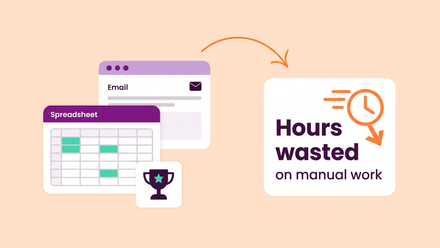
The problem isn’t the content or the speakers. It’s the infrastructure. Every webinar or seminar that runs on a disconnected stack of tools requires someone to set up the meeting link, send the confirmation, schedule the reminders, track attendance, send the post-event feedback form, and reconcile who showed up against the booking list. For a single event, that’s manageable. For a program running two events a week across thirty weeks of the year, it’s the equivalent of a full-time role, and that cost doesn’t appear on any invoice.
The hidden cost of manual event delivery
Associations that offer regular online events as a member benefit tend to price them at zero or close to it. That’s often entirely deliberate: free access to education, networking, and professional development is part of what justifies the membership fee. But “free to members” doesn’t mean free to deliver. The cost is simply displaced from the ticket price to the staff time required to run the program.
For most membership teams, that displacement is invisible until something forces the calculation. A team member leaves. Headcount is scrutinized. Someone asks how long it actually takes to run a monthly webinar, and the answer turns out to be most of a day when you add up the setup, communications, follow-up, and data reconciliation. Multiply that across a full program and the number gets uncomfortable quickly.
Jennifer Sproul, Chief Executive of the Institute of Internal Communication, described the dynamic before IoIC moved to ReadyMembership: “Our HQ team only has 8 people, every week hours of the team’s time were taken up with manual admin and moving data. How could I free up my team’s time and headspace to develop new content and member resources?” The answer, in IoIC’s case, was a platform that automated the processes that were consuming that time. IoIC subsequently saw a 52% increase in membership applications and 25% overall membership growth, outcomes that became possible, at least in part, because the team’s capacity was redirected toward member value rather than administrative overhead.
What automation actually covers
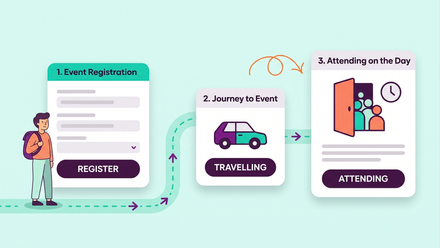
The automation that matters for a high-volume online events program isn’t sophisticated AI or complex workflow logic. It’s the reliable, repetitive execution of a defined sequence: confirmation on booking, reminder the day before, reminder on the morning, a link with attendance tracking five minutes before the session starts, a feedback form sent automatically when it ends. That sequence, running without manual intervention across every event in a program, is what makes volume viable.
Rheanna Smith, Director of Operations at AHOU (the Association of Home Office Underwriters), identified integration with their webinar platform as a deciding factor when selecting ReadyMembership. Their previous system had no GoToWebinar integration, which meant the webinar workflow was always partially manual. “ReadyMembership said, yes, we can do it, and they did it.” That kind of direct platform integration, where the booking system and the delivery tool share data automatically, is what closes the manual gap.
For a small team running a program with a growing and diverse membership base, automation isn’t an efficiency gain. It’s the condition that makes the program possible at scale. Jemma Still, Executive Director of the Cancer Nurses Society of Australia, described the broader automation need in terms her team could act on:
We’re a small team and so we wanted a technology supplier that can increase our productivity by reducing manual tasks, giving us a single view of our data, and segment and personalise communications our members receive based on their interests and interaction with us, driving better member engagement.
The integration question
Automation only works if the systems involved can share data without manual intervention. An event platform that sits outside the membership system requires someone to bridge the gap: exporting registrant lists, importing attendance records, checking membership status before applying pricing rules, or manually segmenting post-event communications. Each of those steps is a point where errors accumulate and time disappears.
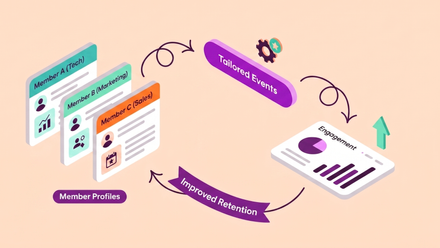
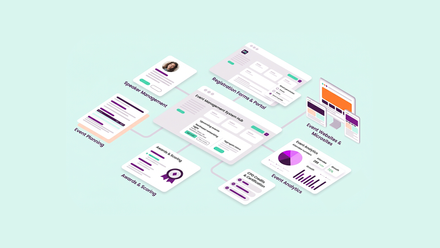
The associations that run the most efficient event programs tend to have resolved this at the infrastructure level. When the events tool is part of the same platform as the CRM, membership records, and email system, the automation runs cleanly: booking confirmation draws on membership data to apply the right pricing and include the right content, attendance records update member profiles automatically, and post-event communications can be targeted based on who actually attended rather than who registered.
Ana Christie, Chief Executive of Sussex Chamber of Commerce, described the impact of that integration simply: the efficiency isn’t incidental to the member offer, it funds it.
Immediately, the fact that the CRM, CMS, as well as Marketing are linked was a huge win for us. So much is automated, helping us streamline our processes, save time and reduce costs. This allows us to focus on developing our business membership offer.
The competitive pressure associations often underestimate
There’s an argument that Damian Hutt, Executive Director of the Association of Association Executives, makes explicitly about the automation of free member events, and it’s worth taking seriously. Commercial competitors to associations (publications, training companies, industry bodies with commercial funding) automate their event communications as a matter of course. They’re not doing it because they have large teams. They’re doing it because the technology makes it straightforward, and because the alternative is either staffing up or doing less.
For associations whose members also receive event invitations from commercial providers, the comparison is implicit but real. A well-timed, relevant, personalized reminder from a commercial training company lands differently than a manually assembled email that went out a day late because someone was covering two roles. The content quality might be equivalent. The operational polish is not.
This isn’t an argument for automation at the expense of human judgment. The program research, speaker coordination, and content strategy that make events worth attending are human work. The point is that automation should be handling the logistics so that human capacity is available for the things that actually require it.
What this looks like in practice
NACA, the National Association of Campus Activities, saw 16 hours per week saved specifically on managing large event delegate bookings after moving to ReadyMembership, with membership renewals dropping from a three-person process to one. Shelly Mumma, NACA’s Board Chair, reflected on what that freed up:
I’m really pleased that our new membership platform has freed up the NACA team to focus on the future, positioning them to develop even better events and online services that bring our community together.
That reallocation, from logistics to program development, is what a well-automated events operation actually produces. The events don’t get cheaper to offer. They get more viable to scale, more consistent to deliver, and more sustainable for a team of realistic size to maintain.
For associations currently running a regular online program on manual processes, the question worth asking isn’t whether automation would help. It’s how much capacity is currently going into tasks the platform should be handling, and what would become possible if it were.