How EAIE used ReadyMembership to grow membership and run a seamless conference for 7,000 attendees
At a glance — Key results
- Conference-registration membership joins up from 52% to 73%
- More than 1,000 memberships taken up at the point of conference registration
- A key financial report cut from two weeks to one hour
- 93% attendee satisfaction at one of the EAIE’s largest conferences
- 96% satisfaction with on-site badge collection
- ReadyMembership runs as a single source of truth, with the conference app, badge printing, and check-in all syncing automatically within about 15 minutes
- More than 7,000 attendees from over 100 countries at the annual conference
- 65 conference ticket types priced automatically from member data, with nothing for the attendee to select
Picking up where the first story left off
When the European Association for International Education (EAIE) moved to ReadyMembership in 2024, the goal was straightforward: replace a patchwork of integrations and manual workarounds with a single platform that could handle the genuine complexity of its annual conference. It worked. The 2024 conference in Toulouse drew the largest attendance in the event’s history, and the project went on to win best digital transformation at the International and European Association Success Awards.
Two years on, the question has changed. It is no longer “can the platform handle what we need?” but “how much more can we get out of it?” And according to Jackie van Doorn, Manager for Projects and Insights at the EAIE, the answer had very little to do with buying anything new.
None of this came from adding more tools. It really came from using our tech systems with a lot more intention.
This is the story of what intention looked like in practice: a redesigned registration moment that lifted membership conversion, a reporting setup that turned a two-week job into a one-hour one, and a single source of truth that quietly removed hours of manual work every day.
The EAIE, by the numbers
The EAIE is a membership organisation based in Amsterdam, with around 3,000 members a year and a mission to support and internationalise higher education across Europe and beyond. It does that through research, resources, professional development, a job board, and a community platform. But its centre of gravity is its annual conference: more than 7,000 attendees from over 100 countries, more than 200 sessions, more than 250 exhibitors, and roughly 80 percent of the organisation’s annual revenue, all delivered by a team of 48.
That scale is demanding, but the real challenge is complexity rather than volume. The EAIE offers 65 different conference tickets, priced against several overlapping variables at once: member or non-member status, a country income tier based on the World Bank index, specific pricing for participants from Africa, the attendee’s role at the conference, and the timing of their booking across early bird, regular, and late phases, plus a range of optional add-ons. Exposing all of that to the person registering would be unusable, and would invite people to simply select whichever option was cheapest.
So one requirement was non-negotiable when the EAIE chose its platform. Pricing and access had to be driven by the data the organisation already held, not by anything the attendee selected about themselves. As Jackie put it, the equity is built into the structure: a participant from a lower-income country does not have to declare it, because the system already knows and already applies the right price. Each person sees only the pricing they qualify for, and the experience stays simple and controlled. Being able to support that logic cleanly, without pushing the complexity onto members, was one of the reasons the EAIE chose ReadyMembership in the first place.
Lesson one: design for output, not just input
Jackie’s role sits deliberately across both projects and insights, which means she is not only configuring the platform to work on the day, but making sure the data it produces is usable long afterward. That shaped how the EAIE set things up.
The team spent real time on naming conventions, down to whether a ticket name used a colon or a dash, so that every ticket could be segmented and parsed consistently when the data was exported. They created early bird, regular, and late pricing phases for every ticket type, even where the price never changed, purely so they could always track when sales happened. And they tested not just whether registration worked, but whether the data they pulled back out could actually build the dashboards they needed.
The first year was a learning year. Naming was inconsistent, pricing phases were not standardised across ticket types, and the data that came back was harder to segment than it should have been. The principle the team carried into year two was a practical one: once registration is live, it is too late to restructure the data, so the report the organisation needs has to be designed before the form is built. Applying that discipline paid off concretely, cutting one financial report that had previously taken two weeks to produce down to about an hour.
Lesson two: the conversion moment is something you design
Conference registration is the EAIE’s single biggest opportunity to convert members each year. It is the one moment when thousands of people are on the website, weighing benefits they can feel at the conference itself, from discounted tickets to the member lounge.
In its first year on ReadyMembership, the EAIE already saw solid uptake. Membership was offered through a form at the top of the registration flow: choose yes, and the system assigned a ticket with membership included; choose no, and it assigned a standard ticket. Technically it worked well. In practice, many people simply scrolled past it without noticing.
The fix was not technical. The logic and the system behaviour stayed exactly the same. What changed was how the decision was presented. The following year, the EAIE replaced the passive form with a pop-up that appeared to every non-member the moment they landed on the registration page. They could not scroll past it and could not dismiss it. They had to actively choose yes or no before continuing. The pop-up also carried a little more context about the value of membership and the potential savings on the conference, so the decision was clear in the moment it was made.
The result was significant. More than 1,000 memberships were taken up directly at the point of conference registration, and the share of membership joins happening through the registration form rose from 52 percent to 73 percent.
The conversion moment is something you have to actively design for. If people can ignore the decision, a lot of them will. But if you bring it to the right moment and make the value clear, they are so much more likely to engage with it.
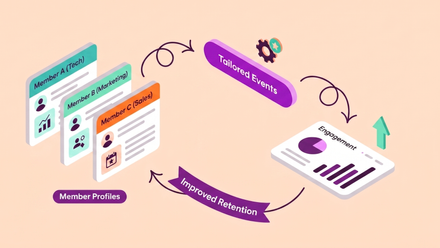
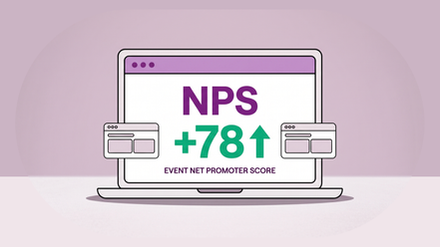
The financial logic holds up too. Even after the membership discount on the conference, a participant who joins as a member still brings in slightly more revenue than one who does not, before any of the longer-term value of an engaged member is counted. And that longer-term value is real. The EAIE consistently sees members report higher satisfaction with the conference and give higher NPS scores than non-members, and the effect lingers even among members who have since lapsed. For the EAIE, that turns membership conversion into something more than a transaction, which is part of why designing the moment so carefully matters.
Lesson three: one source of truth, and the end of manual sync
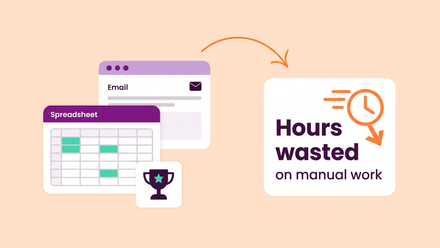
In the early days, a lot of the EAIE’s day-to-day still ran on manual effort. The team exported registrant lists daily, sometimes several times a day, converted them to CSV, and uploaded them into other systems, accounting for every cancellation and add-on as they went. Session data was worse: a speaker change or a room change had to be updated by hand across the website and the event app. It consumed staff hours and introduced constant risk of error.
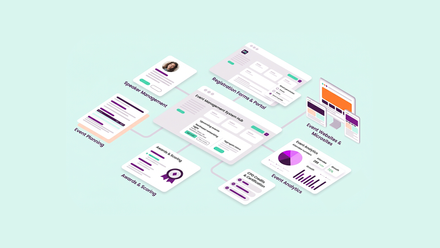
So the EAIE made ReadyMembership its single source of truth. Rather than moving data between systems by hand, they connected them. The conference app now pulls directly from ReadyMembership, so a new participant, a cancellation, or a changed session room is reflected automatically within about 15 minutes. The badge printing system runs off the same data, and check-in is a two-way flow: when someone collects their badge on site, that information feeds straight back into ReadyMembership, so the team can see exactly who has arrived.
Internally, that meant one place to look instead of several, with confidence that the data was right. For attendees, it meant the information in the app was always current. When the sync went live, the hours the team had previously spent manually uploading data disappeared overnight, a change Jackie van Doorn described in a single word: “life-changing.” The attendee experience reflected it too, with badge collection scoring a 96 percent satisfaction rating on site.
The EAIE was deliberate about those integrations, starting with the systems ReadyMembership already supported natively rather than commissioning new ones. Before choosing an event app, the team asked which platforms synced out of the box and selected from that list, on the principle that it is better not to be the first test case for a brand-new integration.
The results
Used with intention over two conference cycles, the platform delivered measurable gains:
- More than 1,000 memberships taken up at the point of conference registration
- Registration-period membership joins via the form up from 52 percent to 73 percent
- A key financial report cut from two weeks to about one hour
- 93 percent overall attendee satisfaction at one of the EAIE’s largest conferences
- 96 percent satisfaction with badge collection on site
- Automatic app updates within roughly 15 minutes, replacing daily manual exports
What’s next
The EAIE’s 2026 conference heads to Glasgow in September, and registration is already off to a great start. Rather than wholesale change, this year is about refining what already works. The team has added the ability for existing members to renew during registration, not just join new, so conversion now happens at the moment of renewal too. They have introduced an exhibitor portal so exhibitors can manage their own profiles and content directly. They are building out visibility of in-progress bookings to understand where people drop off in the registration flow, and investing in how the program of 200-plus sessions is structured and filtered, because the easier it is for a prospective attendee to see what they would gain, the easier it is for them to justify coming.
The thread running through all of it is intent. The EAIE’s biggest gains came not from new technology but from being deliberate: about how the system is configured, about the experience members move through, and about the data the organisation wants back at the end. A partner that behaves as a collaborator rather than a vendor made that possible.
I cannot begin to say how much I appreciate working with people who want to make the best product and want to make sure you have a product that works for you.