How AAE delivers 80 events a year with a team freed from admin
At a glance — Key results
- Approximately 80 events per year, including around 60 online seminars and the annual World Congress
- Around 500 delegates and 100 exhibitors at World Congress
- 36 discrete delegate personalisations across organisation type, role, and geography
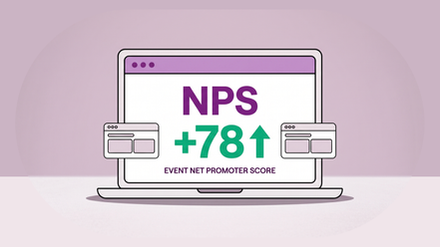
- Net Promoter Score risen from 15 to 62
- Entire online seminar programme managed without a dedicated event coordinator
- Zoom and Vimeo integrated; attendance data feeds back automatically
- Session input forms route automatically to session leaders pre-event
- Mobile app integration and multi-currency support for international attendance
About AAE
The Association of Association Executives is a global association for the people who run associations. Its members are CEOs, membership directors, events leads, and marketing heads from trade bodies, professional associations, and federations across Europe and beyond. AAE exists to help them do their jobs better — through an annual World Congress, a Tech Showcase, forums, member meetings, and a year-round online seminar programme. In total, that adds up to approximately 80 events a year.
The challenge: flying blind on 80 events a year
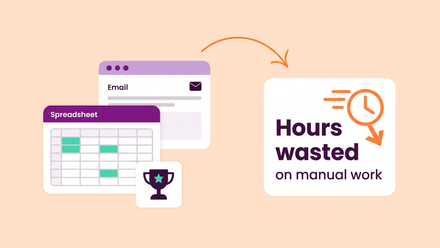
Before ReadyMembership, AAE ran its events on a separate third-party platform with no connection to its membership or marketing systems. Everything that needed to move between those worlds moved manually — exported from one tool, imported into another, reconciled by hand.
That meant every delegate received the same communications. A CEO from a federation received the same promotional email as a head of events from a professional body. A delegate booking into a three-hour deep-dive workshop received the same confirmation as someone attending a plenary session. Specific instructions, tailored recommendations, and role-relevant content were simply not possible on the platform AAE had.
For an organisation that exists specifically to help associations improve how they serve their members, the gap between what AAE was doing for its own delegates and what it was encouraging its members to aspire to was hard to ignore.
There was a second problem, less visible but equally significant. AAE runs approximately two online seminars a week for thirty weeks of the year. Doing that without automation — setting up each meeting link manually, sending individual reminders, chasing feedback by hand — would have required a dedicated event coordinator.
We would not be able to do two seminars a week for thirty weeks here without it. It just wouldn’t be possible.
The turning point
When AAE first moved onto ReadyMembership, the clearest memory of the transition was not the relief of something working. It was the surprise of discovering how much more was possible than the team had come looking for.
My first remembering is looking at the unbelievable personalisation and rules-based system and thinking: we could do even more than we want. My gosh, you could automate based on all sorts of things.
That revelation — that the platform’s ceiling was higher than AAE’s initial ambition — shaped everything that followed.
Automating the seminar programme
Every online seminar AAE runs now triggers the same automated sequence: marketing promotion to members whose tagged interests match the topic, an initial booking confirmation, a day-before reminder, a morning-of reminder, a five-minute pre-session alert containing each attendee’s unique tracking link, and a post-session feedback form. Attendance data from Zoom or Vimeo feeds back automatically. The programme manager creates the event and coordinates the speaker. The platform handles everything else.
That architecture reduces what would otherwise be a logistics-heavy role to one focused entirely on content quality and programme development. It also makes the financial model for free member events viable: without automation, the cost of delivering a seminar programme at this volume would have to be recovered somehow, whether through ticket prices, reduced frequency, or additional headcount.
Personalising the World Congress
AAE’s World Congress attracts around 500 delegates and 100 exhibitors. Attendees come from trade associations, professional bodies, and federations. They are CEOs, heads of events, heads of membership, and heads of marketing. They travel from across Europe and internationally. Every one of them receives a different experience — not through manual segmentation, but because the platform assembles the right content for each person automatically.
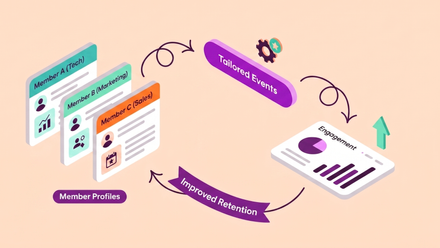
Every promotional email dynamically incorporates recommended sessions, testimonials matched to the recipient’s function, and example peer organisations already registered — all drawn from the same CRM data that manages their membership. As the event approaches, targeted offers layer in: lapsed attendees receive one message, long-distance travellers another, delegates whose organisation has never attended before something different again. As Damian said, "Every email that goes out is personalised. It’s not mass emailing in a normal sense."
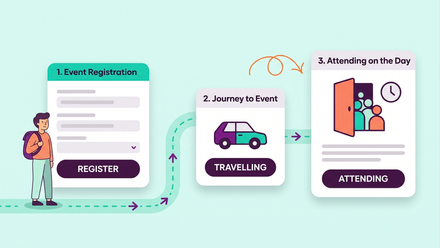
Once booked, delegates enter a structured task journey. A visual dashboard shows each person their progress: completed items marked, overdue items flagged, upcoming deadlines visible. The reminder emails that fire are specific to each person’s outstanding tasks — not a generic nudge, but a targeted message about exactly what that delegate still needs to do, and why it matters.
For delegates booked into deep-dive sessions, the journey goes further. Each person completes a short input form specific to the sessions they’ve registered for, describing their context, their challenges, and what they’re hoping to get from the programme. Those responses route automatically to the session leader, who uses them to adapt the content before the event. By the time the session begins, the leader knows who is in the room, at what level, from what kind of organisation, and what they’re bringing with them.
The table planning tool completes the picture. AAE uses it to seat delegates by level, function, organisation type, and — for event-focused attendees — the scale of events they run. The result is that every deep-dive session is a group of people who are different enough to generate genuine cross-sector insight, and similar enough in role and seniority to have a meaningful conversation.
Delegates feel that we have nurtured the content and the event for them. And they’re able to have more input — because of the ability to gather personalised data from them, which you wouldn’t be able to do without the personalisation tools of ReadyMembership.
AAE’s World Congress Net Promoter Score has risen from 15 to 62 over the period it has been using this approach.
How it evolved
What AAE has built now is not what it set out to build when it first moved to ReadyMembership. The personalisation started with three organisation types. Then the team identified six distinct roles worth addressing differently. Three types by six roles is 18 segments. Then geography: European attendees and international attendees need different things. Eighteen by two is 36 discrete personalisations.
The reason that growth has been manageable, rather than unwieldy, is how the CMS is structured. Adding a new segment doesn’t mean rebuilding the system. As Damian Hutt said, "If you find a new group that’s a significant group of potential delegates, you can add an additional personalised segment. You don’t have to recreate everything again — it’s extremely easy just to add another layer."
Each year, AAE clones the previous year’s personalised content framework and updates the segments for the new programme. The cumulative investment compounds rather than restarts.
The same pattern has played out with the feedback and evaluation system. AAE now uses ReadyMembership’s forms tool to gather event feedback in a way that’s integrated into the event page itself, chasing incomplete responses automatically rather than relying on a follow-up email blast.
Being able to integrate that and have it on the events page — getting people to complete it, and if they don’t complete it, chasing them — has been something we could never have done before.
What the platform makes possible at scale
One of the things Damian observes about ReadyMembership is that it handles small and large events through the same architecture — without forcing teams to choose between a platform that works simply for simple events and a different, more complex system for complex ones. "When I’ve come across other systems, they are incredibly complicated all the way through — when you’ve got a small event, it’s just too complicated. And others: when you’ve got a large event, they can’t do what you want."
The ReadyMembership system handles a 20-person seminar and a 500-person congress through the same rules engine, the same delegate journey logic, and the same communications system. The complexity of what the platform does is proportionate to the complexity of the event — and the operational overhead doesn’t scale linearly with attendance.
We wouldn’t have to do any more work if it was 10,000 or 15,000 or 20,000 people, because it’s automated.
Looking ahead
AAE’s current events programme is concentrated in mainland Europe and the UK. Its community extends to North America, the Middle East, Southern Asia, and East Asia — and the demand for regional programming in those markets is growing. The next phase of AAE’s use of ReadyMembership involves expanding the programme to serve those regions: new seminar tracks personalised by geography, and membership pricing adapted to reflect the financial context of different markets.
The platform’s flexibility to add personalisation layers — the same mechanism that took AAE from three segments to 36 — means that geographic expansion doesn’t require rebuilding the approach from scratch. It means adding to what’s already there.
Every day on our previous system, I found two or three things we couldn’t do, and it was very annoying. When we moved to ReadyMembership, I just felt: there is so much more we can do. I absolutely recommend it.