Visible, verifiable, valued: how ITI makes membership matter in an unregulated profession
At a glance — Key results
- The public member directory has drawn more than 21,000 visits from over 5,000 active users in 2026 to date
- Visitors spend an average of close to three minutes engaging with directory results rather than bouncing away
- Hundreds of Member Check verifications completed every month, covering marriage certificates, qualifications, court documents, and more
- A UK government body responsible for verifying overseas qualifications directs the public to ITI’s directory as a trusted source for qualified professional translators
- CPD automatically logged when members attend ITI events, with Zoom and Teams connectors confirming genuine attendance
- 2,600+ individual members and 100+ corporate members supported by an in-house team of around seven
The Institute of Translation and Interpreting supports language professionals who work in a market with almost no rules. In the UK there is no statutory regulation of translation or interpreting, no protected title, and no legal requirement to hire a qualified professional linguist. Anyone can call themselves a translator. Anyone can set up as an interpreter tomorrow, with no training and no oversight. As ITI’s chief executive, Sara Robertson, puts it, it is “the wild west out there.”
So how does ITI promote the professionalism of its members in an unregulated market? With around 2,600 individual members, roughly 100 corporate members, and a team of about seven, ITI is not a large organization, but the ReadyMembership platform provides the ability to build the professional credibility of its members and make that credibility findable, checkable, and worth the effort to earn.
The members ITI serves, and the problem of invisibility
ITI’s members are overwhelmingly self-employed translators and interpreters, highly skilled in language and usually specialized in a field such as law, finance, medicine, or one of the less obvious niches like sports, media, and luxury brands, where the precise choice of words carries real weight. Many built their careers working through agencies and language service companies. As that model shifts and members increasingly work directly with clients, the pressure to be discoverable in their own right has grown.
The difficulty is that good translation is invisible by design. When a document reads naturally, or an interpreter in the booth goes unnoticed, it’s no surprise that the professional behind the work rarely gets the recognition that the skill deserves. Many members are motivated by their passion for languages rather than by selling themselves. So ITI’s task is not only to promote professionalism but to make it visible to the people who need it.
Professionalism as the answer
ITI’s response to an unregulated sector is to define and uphold what professionalism means. It sets this out through seven hallmarks that will be familiar to anyone working in a professional body: holding specialist knowledge and expertise, holding recognized qualifications and credentials, adhering to a code of conduct, maintaining and updating skills through CPD, exercising independent judgment, putting client and public interest above self-interest, and taking responsibility for the work.
Three of those hallmarks are where the platform does its most visible work, and they map neatly onto how Sara describes ITI’s digital offer: visible, verifiable, valued.
Visible: the directory
The clearest expression of ITI’s standards is its public directory, and it is reserved for qualified members only. Members who pass ITI’s assessment earn MITI status, and the right to be listed in the directory. Having an entry in the Directory is a public marker of competence, and a service ITI offers to anyone looking for a professional they can trust.
The directory comes as standard functionality in ReadyMembership, but ITI has tailored the search to its sector. Users choose one of four routes, finding a translator, an interpreter, a conference interpreter, or a language service company, then narrow by source and target language and by a granular set of specialisms. Around it sit resources explaining what a professional translator does, the difference between a human professional and machine translation, and how to brief a translator well.
Members control their own profiles, listing their languages, specialisms, associated skills such as proofreading or copy editing, the translation technology they use, and a CV if they choose. Getting members to make the most of that freedom is an ongoing job: some profiles are excellent, some are thin, and ITI runs webinars and guidance to help members present themselves well.
The directory is well used by the public. In 2026 to date it has drawn more than 21,000 visits from over 5,000 active users, who spend an average of close to three minutes engaging with results rather than bouncing away. ITI uses that evidence both to demonstrate value to existing members and to encourage others to qualify and be listed.
ITI members value the directory because it generates enquiries. One UK government body responsible for verifying overseas qualifications points people directly to ITI’s directory as a way of finding a professional translator they can rely on, precisely because document fraud is a real risk in some markets. Members report being found and hired through it: one recently qualified member shared publicly that a new client had reached her directly through her directory listing. Members also use it among themselves, recommending colleagues for projects outside their own specialism, so the directory doubles as a quiet referral network within the profession.
Verifiable: Member Check
The directory has a second job: letting anyone confirm that a translator is who they claim to be. This matters most for Certified Translations, the catch-all term for a process that provides a guarantee that the documents required by courts, government departments, and other authorities have been translated professionally. In practice anyone can label a translation as certified, so the value lies in being able to check that the linguist belongs to a professional association and has signed up to its Code of Professional Conduct. Many commissioning bodies specifically ask for an ITI member, and ITI provides certification seals members can add to their work.
Member Check closes the loop. It is a simple public lookup: type in a name, with no login or account required, and confirm whether that person is a qualified member. It is used regularly, running to hundreds of checks a month, for exactly the documents you would expect, including marriage and divorce certificates, qualifications, and material headed for the courts. In a sector with no regulator, it gives the public a fast, free way to separate genuine professionals from anyone claiming the title.
Valued: CPD
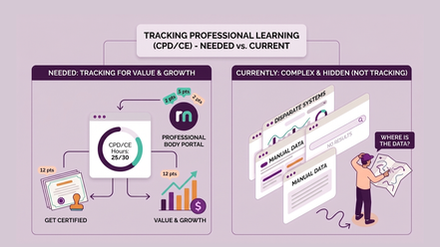
The third hallmark the platform supports is the commitment to keep learning. ITI’s CPD logging tool sits inside the member area and lets members create an annual plan and record activity against it. Some of that recording happens automatically: when a member books onto an ITI event run through the platform’s event tools, the CPD is logged for them, and the platform’s Zoom and Teams connectors monitor attendance, for example confirming a member stayed on a webinar long enough to genuinely earn the CPD points rather than logging on for five minutes. Members can edit their logs and add reflections on what they took from each activity.
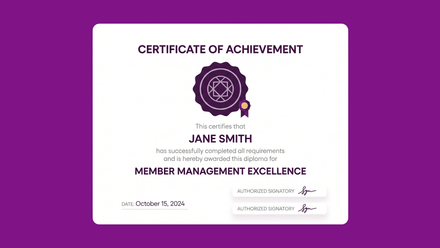
The tool gives members something they can use commercially. They can download a certificate confirming their CPD hours and put it in front of clients, which matters for specialists who need to show they are staying current in fast-moving fields. ITI recommends 30 hours a year, and a visual dial tracks progress toward this goal.
ITI has also gamified CPD, with coloured badges for reaching thresholds and a small confetti celebration when members pass them. It has prompted a friendly competitiveness, with some members logging many times the recommended hours. Sara is candid that this approach rewards quantity as much as quality, and that not every logged hour is a result of serious study rather than a documentary watched in another language, but it has proved a genuine motivator, and engagement is highest among exactly the qualified members ITI most wants to keep active.
Why it works for a small team
ITI's use of the platform is, by Sara's own cheerful admission, not the flashiest in the room. That is the point. For an organization of around seven people serving 2,600 members, what matters is straightforward, stable systems that do the job well, with enough flexibility to fine-tune them as needs change. ITI regularly reviews and adjusts its CPD categories, for instance, adding wellbeing as members asked for it, all from within its own control.
There is honesty about the wrinkles too. A simple decision to refresh the logo turned into a long hunt for every place it appeared across badges, certificates, and the site, a reminder to think about the downstream work before making a change. But the verdict is clear: the system does what ITI needs, members give good feedback on both the directory and the CPD tool, and Sara, now on her second professional body running ReadyMembership, knows what good looks like from experience.
In a profession where membership is optional, that is how ITI makes it matter, every day.
What matters to us is having relatively straightforward, stable systems that just do the job really well, with enough flex that we can fine-tune things as we go. In a sector with no regulation, the platform is a big part of how we help demonstrate our credibility and the professionalism of our members.