Does your AMS actually support certifications, or just tolerate them?
Most association management systems will tell you they support certifications. And technically, many of them do, in the same way a filing cabinet supports certifications. They can hold a record. They can note that a credential exists. What they cannot do, in most cases, is manage the living, moving process that sits behind that credential: the applications, the eligibility checks, the committee reviews, the exam scheduling, the CPD tracking, the recertification cycles, and the benefits that should flow automatically once someone earns their designation.
The gap between storing certification data and actually running a certification program is wider than most associations realize until they are deep into implementation. And it is a gap that creates real costs, in staff time, member frustration, and missed opportunity.
What “supporting certifications” usually means in practice
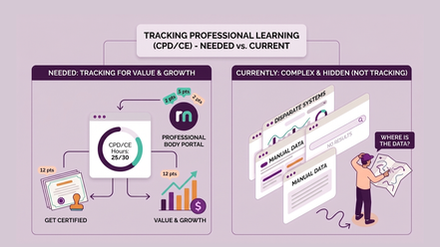
When I talk to associations about how they currently manage their credentialing programs, the picture that emerges is remarkably consistent. Certification data sits outside the core CRM, usually in a spreadsheet, sometimes in a third-party tool, occasionally in both. The connection between a member’s credential status and everything else the organization knows about them (their membership grade, their CPD activity, their event attendance, their renewal date) exists across disparate systems and databases.
That is rarely the result of a bad decision. What I usually find is that the AMS they are on handles membership well enough, maybe events too, but certification was never really in scope when it was built. So it gets captured as a field, or a record type, but there is no workflow behind it. No front end for candidates to apply through, no automation to move an application forward, no connection between what is logged in the certification module and what the rest of the system knows about that member. It exists in the system in name, but in practice it is being administered almost entirely outside it.
The practical consequences accumulate quickly. Administrators spend time manually cross-referencing spreadsheets just to confirm whether a candidate meets eligibility criteria, because the system cannot check that automatically. Applications arrive in committee members’ inboxes as email attachments rather than routing through any kind of structured review workflow. Sponsor forms get chased by hand, cycle after cycle, because there is no mechanism to generate and send them from the platform. And when a certification lapses because a membership expired and nothing connected the two records, nobody finds out until a member calls to ask why their access has changed.
Where the real complexity lives
Part of what makes certification management genuinely difficult is that it is not a single workflow. It is a series of interdependent processes, each of which needs to connect cleanly to the others and to the wider membership record.
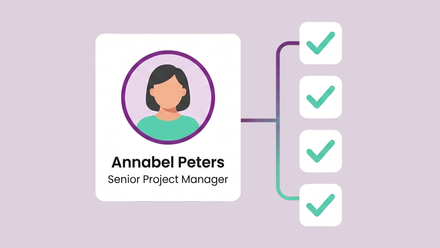
A candidate applying for a credential may need to demonstrate a certain number of years of professional experience, hold an active membership subscription, have completed a defined number of continuing education credits, and provide references or sponsor attestations. Each of those criteria needs to be checkable at the point of application, not manually verified by a staff member afterwards. When the criteria are tiered (a basic designation has different requirements from an advanced one), the complexity multiplies.
Once an application is accepted, it needs to route to the right reviewers. Committee members should be able to see the relevant information and record their decision without downloading PDFs or logging into a separate system. When a decision is made, the candidate should be notified automatically, and if the next step is an examination, the pathway to that exam should open without another manual intervention.
After a credential is awarded, the work does not stop. Recertification cycles need to be tracked against continuing education activity the member has actually logged, and when someone is approaching a deadline without having met their requirements, the system should be able to flag that proactively, ideally pointing them toward relevant learning or events that would count toward their credits.
That last capability (the proactive, joined-up kind) is only possible when certification data is genuinely connected to the rest of the member record. If the CPD tracker lives in one system and the certification record in another, there is no mechanism for one to inform the other in real time.
The connected record question
The most useful test I have found for whether an AMS genuinely supports certifications is what I think of as the connected record question: does the system know, at the point of any interaction with a member, what their credential status is, and does that status affect what happens next?
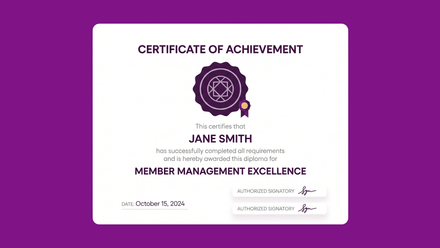
For a platform that truly integrates certification management software for associations, the answer is yes throughout the member lifecycle. A member who has just earned a designation should automatically gain access to the content, directories, or benefits that come with it, without a staff member manually updating their record. If a member’s certification is at risk of lapsing because their membership has expired, the system should flag it, because it understands that membership is a prerequisite for holding the credential. A candidate partway through an application who has not yet logged sufficient CPD credits should receive a prompt, because both records are visible in one place.
None of this is possible when certification data is siloed. And yet siloed is exactly how most associations are managing it, not because they want to, but because their AMS has given them no alternative.
What genuinely integrated certification management makes possible
When certification workflows are built into the AMS rather than alongside it, the difference is felt at every stage of the process. Applications become self-service, with eligibility checks running automatically and candidates able to see their own status in real time. Committee review happens within the same environment as every other organizational workflow, with automated routing and batch processing replacing email chains, and results trigger the next step without a staff member having to connect the dots.
The American Association of Professional Landmen (AAPL) offers a useful illustration of what this shift looks like in practice. Before moving to ReadyMembership, AAPL’s certification program (covering three credential levels for land professionals across the US energy industry) was administered through a combination of paper affidavits, downloaded spreadsheets, and email-based committee review. Processing a single applicant required a certification administrator to navigate 10 steps just to verify sponsor forms. Committee members opened multiple PDFs per applicant and clicked through six screens to record an approval.
The certification program was our biggest requirement. It’s part of our whole mission. And the pain points were so high with our current system that it was a huge component for us. Most of them couldn’t handle it.
After implementing ReadyMembership, the same review process now takes 3 to 4 steps per applicant rather than 10. The end-to-end cycle, from application to exam setup, has been reduced from 4–6 weeks to 2 weeks or less. In the most recent comparable review cycle, all 43 applications were completed and approved. In the equivalent period a year earlier, 7 of 18 assigned applications were never submitted or reviewed by the deadline.
The ease now with just checking a box on the verification versus what they had to do before. It’s literally game changing.
The question worth asking your AMS provider
If your organization runs a certification program and you are evaluating your current platform (or considering a new one), the question to ask is not “does this system support certifications?” Almost every vendor will say yes. The better question is: where does the certification record live in relation to the membership record, and what happens automatically when something changes in either?
If the answer involves exports, manual updates, a separate tool, or any version of “your team would handle that,” you are looking at a system that tolerates certifications rather than one that genuinely supports them. The difference, in practice, is the difference between a program that runs and a program that works.
To see how ReadyMembership handles the full certification lifecycle, from configurable application workflows and committee review tools through to automated recertification and digital credential issuance, explore the certification management features.