CPD tracking without the admin headache
Most associations have a CPD problem they don't fully account for. Not the program itself, which is usually thoughtfully designed, but the infrastructure behind it. Somewhere in your organization, a staff member is spending hours every week reconciling event attendance against spreadsheet records, manually updating member profiles, and fielding queries from members whose dashboards don't reflect what they've actually done. That time has a cost. And because it's distributed across inboxes and admin queues rather than sitting in a single line on a budget, it rarely gets examined. This is the admin headache that professional associations have quietly normalized, and it's time to talk about it.
The spreadsheet problem nobody talks about
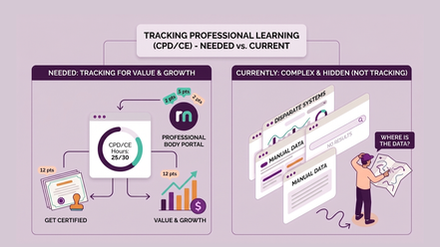
Ask any Membership Director how their team tracks CPD and the answer is usually some version of the same story. There's a spreadsheet, or several, a manual process for logging points after events, and an inbox somewhere that collects member queries about records that don't add up. The staff members doing this work are capable, well-intentioned people spending a meaningful portion of their week on data entry that adds no strategic value to the organization.
This isn't a people problem. It's a systems problem. CPD activity doesn't happen in one place — members earn points or hours from events, webinars, online courses, conferences, and self-directed learning, and each of those touchpoints is typically managed by a different tool. That means someone has to manually reconcile data across multiple systems before a member's record is anywhere close to accurate, and by the time it is, the member has already emailed asking why their dashboard doesn't reflect what they attended last month.
The operational drain is significant, but the member experience cost is arguably more serious. Members who can't get a clear, up-to-date view of their own CPD progress are members who feel that their association isn't working for them, and in a sector where retention is hard-won, that friction matters more than most teams realize.
What associations get wrong about CPD technology
A common response to the spreadsheet problem is to add another tool. Associations bolt on a learning management system or adopt a CPD-specific platform without thinking carefully about how it connects to everything else, and the result tends to be more systems to manage and more manual reconciliation rather than less. The admin burden doesn't disappear — it just moves around.
The real shift happens when CPD tracking stops being its own separate problem and becomes part of how the membership platform works. When a member attends a conference session, the CPD points should flow automatically into their record without anyone having to make that happen. When they complete an online course, their progress should update in real time. When they log in to their member dashboard, what they see should be accurate as a matter of course. This requires thinking about CPD not as a standalone function but as one thread in a connected membership experience, and that's a meaningfully different way of approaching the problem.
The member side of the equation
It's easy to focus on the operational burden because that's where the pain is most visible internally, but CPD admin frustration isn't only felt by staff. Professionals who rely on their CPD records for regulatory compliance, certification maintenance, or employer reporting need those records to be accurate, accessible, and easy to download on demand. Having to chase their association for a summary, navigate a separate portal with different login credentials, or manually compile records from multiple sources is a poor experience that reflects on the perceived value of membership, regardless of how strong the underlying program actually is.
For associations where professional credentials are directly tied to career progression or regulatory standing, the stakes are higher still. A member who can't easily evidence their CPD isn't just mildly inconvenienced — they may genuinely start to question what their membership is doing for them.
What better looks like in practice
Associations that have moved CPD tracking into a fully integrated membership platform typically describe the same shift: the team stops being the middleman. When CPD points are automatically assigned to events, conferences, and courses at the point of setup, they flow through to member records without staff intervention. When a member completes an activity, their totals update automatically regardless of whether they're tracking by points, by hours, or by both. When renewal comes around and a member needs to evidence their CPD for the year, they can filter and download their own summary report without contacting the office at all.
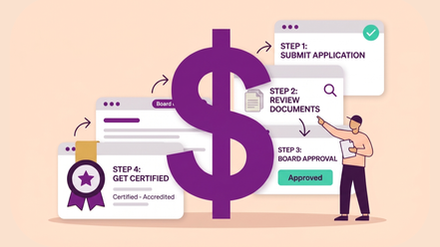
The American Association of Professional Landmen (AAPL) is a good example of what this looks like in practice. Managing a three-tier certification program across roughly 12,000 members, AAPL's team had been tracking candidate progress through spreadsheets and processing applications through a paper-heavy, multi-step manual workflow that stretched the review, approval and exam setup cycle to between four and six weeks. Since moving to ReadyMembership, that same end-to-end process now takes two weeks or less. What once required a certification administrator to navigate ten steps to check a single application is now completed in three to four. Andrea Spencer, AAPL's Director of Communications, describes the difference as "literally game changing." The platform hasn't just saved time — it has made the certification program function as the flagship member benefit it was always meant to be.

This kind of integration matters most where credentialing is closely tied to professional standing, because when the data is accurate and the process is seamless, the association can focus on running a strong CPD program rather than administering the records it generates.
How ReadyMembership handles CPD tracking
ReadyMembership is built around the idea that CPD should be something members engage with, not something they and your team have to work around. The platform supports tracking by points, by hours, or both simultaneously, so it can accommodate however your scheme is structured, and members log their own CPD activities through self-service pages that auto-populate their profile data to reduce the effort involved. Draft auto-saving means a member who gets interrupted mid-submission won't lose their progress, and every entry is time-stamped and auditable, with a full history of activity and any amendments maintained in the system — something that matters considerably for organizations subject to compliance requirements or external scrutiny.
Where the platform becomes significantly more powerful is in how CPD tracking connects with the rest of the membership system. Events managed through ReadyMembership's Eventfolio module can be configured to automatically award CPD points to attendees based on criteria that reflect how your program actually works. If attendance at a minimum number of conference sessions is required to qualify for points, or if a certificate should only be issued when a member meets a specific threshold, the system can handle that automatically rather than relying on manual checking after the fact.
Online learning through the integrated Brightspace LMS works on the same principle. CPD points assigned to courses update automatically in member records as progress is completed, with single sign-on meaning members access their learning without leaving the platform. That connected journey from course purchase through to completion and updated CPD record is one of the more tangible operational improvements associations notice when they move away from disconnected systems, because it removes an entire layer of manual work that previously sat between those steps.
On the reporting side, staff have full visibility of CPD records within the CRM, with the ability to filter and segment by CPD status, points or hours earned, and audit selection. Dashboard widgets surface completion rates across the membership, making it straightforward to identify where engagement is strong and where some targeted outreach might be warranted. The rules engine extends this further, allowing automated communications to be triggered based on CPD status — whether that's a reminder to members who are approaching a deadline, a prompt to those who haven't logged activity recently, or a recognition message to those who've hit a milestone — without staff having to identify and contact each individual manually.
ReadyIntelligence, ReadyMembership's AI-powered admin assistant, also supports staff in managing CPD queries more efficiently. Available within the admin area and trained on platform documentation, it helps your team find answers to configuration questions quickly, without needing to search through manuals or wait for a support response.
Making CPD a membership advantage
The associations that get the most from their CPD programs are the ones that have stopped treating it as an administrative function and started treating it as a strategic one. When tracking is automated and records are accurate, the data CPD generates becomes genuinely useful — you can see which learning pathways are most popular, which members are most engaged, and which segments might benefit from a targeted communication about an upcoming course or a certification deadline that's approaching. That's a very different conversation from the one happening in most association offices today, where the primary question isn't what the CPD data reveals but how to get it into one place in the first place.
Getting the infrastructure right is the prerequisite for everything else. Members who trust that their records are accurate and can access them without effort are more likely to engage with your learning offer and more likely to see the value of their membership come renewal time. Fixing the admin headache isn't just an operational win — it's a member experience strategy.
Want to see how CPD tracking works in ReadyMembership? Explore the learning and CPD features.