How AAPL replaced six disconnected systems and transformed its certification program with ReadyMembership
At a glance — Key results
- Over $200,000 in annual technology costs replaced by a single, unified platform
- Six separate systems consolidated into one, eliminating duplicate data entry and manual workarounds
- Certification management transformed from months-long, paper-heavy processes to streamlined digital workflows
- 600 student membership applications per year, previously entered by staff one by one, now handled through automated self-service
- Real-time reporting replacing overnight data syncs and manually compiled spreadsheets
- Staff empowered to self-serve on reporting and content updates, without needing technical support

About AAPL
The American Association of Professional Landmen (AAPL) is the national association for land professionals working across the US energy industry. Founded in 1955, AAPL represents around 12,000 individual members who work at the business end of energy development, negotiating land and mineral rights on behalf of oil, gas and renewable energy companies. It is a role that sits at the intersection of law, relationships and commercial negotiation, and one that carries significant ethical responsibility.
AAPL's work spans professional development, legislative advocacy, ethics standards, and one of the most complex certification programs in the association sector. Its three-tier credentialing system, covering Registered Landman (RL), Registered Professional Landman (RPL) and Certified Professional Landman (CPL), is central to the professional standing of its members and requires careful management of applications, sponsorships, exams, continuing education credits and recertification cycles.
The challenge: six systems, one very expensive problem
When Andrea Spencer, AAPL's Director of Communications, began building the case for a new technology platform, the organisation was running on six separate systems simultaneously — and paying dearly for the privilege. "We were spending over $200,000 in annual fees," Andrea recalls. "And it wasn't even working. I mean, it was horrible. We were literally hemorrhaging money to make it work, and it still didn't work."
The stack had grown organically over a decade on Personify, AAPL's core AMS. Because Personify was built on an accounts receivable foundation and lacked the flexibility to adapt to AAPL's evolving needs, the team had turned to additional vendors to fill the gaps: an additional learning and event management platform, a communities tool for member discussions, a separate email marketing platform, a scholarship management tool, and an external website developer. Each system had its own login, its own data, and its own quirks.
The practical consequences were felt every day. A typo in a course description had to be corrected in Personify, then on the website, then in the LMS — and even then, there was no guarantee all three would match. Data synced overnight rather than in real time, meaning staff could spend an afternoon entering information they couldn't verify until the following morning. Reports were so difficult to produce that AAPL's systems analyst spent significant time writing custom SQL queries just to pull basic membership numbers — and even then the results weren't always reliable.
"We always had to do it manually and add it to our reports," Andrea explains. "We never could pull a number out about a segment of our membership. Never, ever, ever."
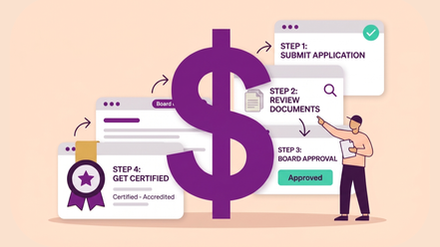
The certification program illustrated the problem most clearly. What should have been a flagship member benefit had become an administrative ordeal. Candidates had to download multi-page affidavit forms, complete them by hand, scan and upload them, and wait while the certification committee downloaded, reviewed and manually processed each application. Sponsors faced the same paper-heavy process. Staff tracked everyone's progress through spreadsheets, terrified of losing someone in the process.
"I can't even tell you how much time it would take someone to go through that process," Andrea says. "A lot of people wouldn't even bother. It was just such a pain."
Perhaps most frustrating of all was the cost of change. Every time AAPL wanted to make even a minor modification to Personify, the price was prohibitive. "We wanted an add-on for a question in the renewal process, and that was basically a $30,000 add-on," Andrea recalls. After ten years of this, the organisation had finally reached its limit. It was time to stop adding sticking plasters and start fresh.
The decision: why ReadyMembership stood out
AAPL's evaluation process was thorough. Over the course of roughly a year the team saw around 20 demos, and worked through a rigorous shortlist. ReadyMembership was a recommendation and from that first demo, two things stood out.
Website integration
Andrea had grown frustrated with maintaining a separate website that was perpetually out of sync with the membership system, and she was immediately drawn to the idea of a platform where content, member data and communications all lived together.
"I really loved the website integration. That was a huge component for me," she says. "I didn't love how different it was and how hard it was to constantly be updating things. And I'm also someone who wanted our site to market to our members in a way that would help us. Why are we sending communications to people who are already registered for something?"
Flexibility
After years of paying five-figure sums for minor tweaks, AAPL needed a system that could grow and change with them without constant additional investment. "We wanted to be able to make changes ourselves," Andrea explains. "If tomorrow we need to make a change, we want to be able to make those ourselves."
Critically, ReadyMembership was also one of the only platforms that could handle AAPL's certification program in full, without requiring a separate integration. For most other vendors, this was a dealbreaker.
"The certification program was our biggest requirement," Andrea says. "It's part of our whole mission. And the pain points were so high with our current system that it was a huge component for us. Most of them couldn't handle it."
The combination of capability, flexibility and the quality of the Pixl8 team's engagement through the RFP process ultimately brought everyone on board. "From a customer service aspect and just functionality, you cannot find a better system out there," Andrea says. "I've already done the homework for you."
The implementation: building something that fits
The project involved significant complexity, including a massive data migration from a decade's worth of Personify records, and the build-out of custom workflows to support AAPL's unique certification and membership structures.
The Pixl8 team's approach to that complexity made a lasting impression. Rather than simply building what AAPL asked for, they listened carefully to how the organisation worked and made recommendations that improved on existing processes.
"We learned a lot about ways we could do things better because of them," Andrea says. "We came in saying we're not married to our processes. If we can make things better, that's great. And there were a lot of places where they said, what if you did it this way? And it was like, yes, let's do that."
The project was timed to avoid AAPL's peak membership renewal period. The transition to a new system over the holiday season created some challenges around staff training timing, and the team acknowledges there were things learned in the first weeks post-launch that shaped how they approached subsequent configuration. But the platform's ease of use accelerated adoption significantly.
"Right away it was very deer in headlights," Andrea says of staff reactions. "But now I keep getting comments about how much they love working in it. People who were not early adopters are saying the more I'm in there, the more I'm using it, I just love it."
The results: from chaos to clarity
One platform instead of six
The most immediate impact was financial. Moving from six systems to one replaced over $200,000 in annual technology spend, while actually delivering more functionality than the combined stack had ever managed.
Beyond the cost saving, the operational difference of working within a single, integrated platform has been transformative. Data updates immediately rather than overnight. Content changes made in one place are reflected everywhere. Staff who previously had to route report requests through a technical colleague can now pull the numbers they need themselves.
"When our president calls and asks how many members we have, I don't have to say 'let me pull a report'," Andrea says. "I can just look up the live number."
Certification management: from months to manageable
The transformation of the certification program has been one of the most significant wins. What once required months of manual processing — paper affidavits, spreadsheet tracking, committee downloads, back-and-forth emails — is now managed digitally through ReadyMembership's workflows.
Processing a single applicant's documents previously required a certification administrator to navigate 10 steps just to check that each sponsor form was completed correctly — and that process had to be repeated separately for affidavits and transcripts. Committee members then had to open up to three separate sponsor PDFs per applicant and click through 6 screens to record an approval or denial. The entire review, approval and exam setup cycle took between 4 and 6 weeks, depending on when sponsors returned their completed forms. In a particularly demanding period, 18 applications were assigned for review and 7 were not submitted or reviewed by the deadline.
The results are striking. What previously took a certification administrator an entire day to process is now handled through automated workflows. Sponsor affidavits are generated automatically, credit years are tabulated by the system, and all applications are housed in one central location — no spreadsheets, no downloaded PDFs, no manual email chains. Checking an application now takes 3 to 4 steps rather than 10. Committee members receive automated notifications with direct links to review applications, and approvals or denials can be recorded in under 10 steps for the entire review batch.
The exam notification and grading process has seen a similar transformation. What previously required opening at least 10 separate windows per applicant to notify and record exam eligibility — and another 9 screens per applicant to process results — is now handled through a single weekly email sent to all approved candidates simultaneously, with grading and status updates completed within the system.
The impact on throughput is measurable. In the most recent comparable review cycle (January to February 2026), all 43 applications assigned for review were completed and approved. In the equivalent period a year earlier, 18 were assigned and 7 were not submitted or reviewed by the deadline. The end-to-end review, approval and exam setup process, which previously took 4 to 6 weeks, now takes 2 weeks or less.
Since launch, 10 members have already completed the full certification journey through ReadyMembership — applying, testing and becoming certified — in a period that would previously have seen most candidates still waiting for committee review. As of early March 2026, 107 applications have been submitted through the platform, with 43 approved to test and 9 currently under review.
"The ease now with just checking a box on the verification versus what they had to do before — it's literally game changing," Andrea says.
Student membership: eliminating a months-long manual process
AAPL's student membership programme had been sustained by a remarkable amount of manual effort. Each year, around 600 students applied, and because the previous system could not handle automated renewals, a staff member manually re-entered every single application. The process began in August and ran for months.
That process is now fully automated, including a branching workflow that distinguishes between students from AAPL-accredited universities (whose memberships are funded by AAPL and approved by a designated programme director) and those from other institutions.
The time savings are measurable. What was previously a 15-minute manual data entry task per application has been reduced to an 8-minute review — a 57% reduction in time per application. The number of steps involved tells the same story: entering an application previously required around 8 steps, adding an invoice to an account took 6, and logging a payment took a further 5. Those same tasks now take 2 steps, 1 step and 1 step respectively. Batch payment processing, which previously required individual manual entries for each member, is now completed in a single action. Across 600 student applications a year, the cumulative impact is substantial.
Reporting: real data, in real time
Quarterly board reporting used to be a source of anxiety. Numbers were unreliable, reports were difficult to produce, and data only synced overnight — meaning there was always a lag between reality and what the system showed.
That has changed entirely. Dashboard reporting is now live and accessible to anyone who needs it, without specialist knowledge or a request to the technical team.
"I finally feel like I know what I'm doing there now," Andrea says of the reporting capability. "Anyone can go and get it. We don't need someone to go pull a spreadsheet."
Member and staff experience
Members have noticed the difference. Feedback from AAPL's annual conference and wider membership has been consistently positive, with members both commenting on the improved experience and proactively suggesting enhancements that the team has been able to implement.
"They love the look and feel. They love how fresh it is. They love that it's easy for them to find things. We've had nothing but great feedback from our members," Andrea says.
For staff, the shift from a system that required specialist intervention for basic tasks to one that genuinely supports self-service has changed how the team works. Rather than spending time on manual data entry and workarounds, there is now capacity for more strategic work — following up with students approaching graduation, tracking lapsed members, and taking on committee projects that previously fell to the bottom of the pile.
Looking ahead
AAPL has a busy roadmap of features still to activate. The awards module will transform the scholarship application process, replacing a paper-based system for distributing $250,000 in annual awards. Submissions functionality will streamline the 15-plus forms that members currently submit by email, from ethics complaints to mentorship applications. An online advertising booking system is in development that will eliminate another manual, spreadsheet-driven workflow.
AAPL is also exploring ReadyIntelligence, ReadyMembership's AI solution, with legislative tracking — currently a manual process across 1,000 bills — among the areas where Andrea sees significant potential.
"There's just so many opportunities for efficiency using the AI component," she says. "We have a person who manually tracks 1,000 different bills. Having that be part of our system — there are just so many opportunities."
For Andrea, the experience has been straightforwardly positive. "I can't say enough good things about the Pixl8 team."
"Don't hesitate," she says, when asked what she would tell another association considering the platform. "From a customer service aspect and just functionality, you cannot find a better system out there. Save yourself some time and give them a call."