Chapter websites for associations: what your AMS should support
Three levels of chapter web presence
Chapter web presence is not one thing. The right setup depends on how developed each chapter is, how much autonomy it needs, and how much administrative capacity it has. A platform that supports only one model forces you to design the whole network around either the most complex chapter or the most basic one.
Chapter pages within the national site. This works well for smaller or newer chapters that need a local presence: event listings, leadership information, region-specific content. No chapter volunteer manages a separate platform. Everything sits within the national site structure, content is managed centrally or by chapter leaders with scoped access, and the branding stays consistent.
Chapter sub-sites. A chapter sub-site is a distinct web presence with its own logo, color scheme, navigation, and domain alias, running on the same platform installation as the national site. It suits chapters that have grown to the point of needing, and being able to sustain, a genuine independent identity. The chapter administrator manages their site’s pages, navigation, SEO settings, and imagery without touching anything outside their scope. National staff set those boundaries. Chapters operate within them.
Microsites. A microsite is a purpose-built, distinctly branded site for a specific event or campaign: an annual chapter conference carrying sponsor branding, or a membership recruitment push. Until recently this required custom development. In ReadyMembership it is something a chapter administrator can configure through the Site Themer tool, setting colors, fonts, and custom CSS without a developer. When the campaign ends, the microsite can be deactivated or archived.
A platform that lets chapters start with pages, grow into sub-sites, and spin up microsites as needed reflects how chapter networks actually evolve. One that demands a fixed architectural decision on day one does not.
What chapter admins can and cannot do
One of the most important questions to ask any AMS vendor is what a chapter administrator sees when they log in, and what is genuinely outside their reach without involving national staff.
In a well-built multi-site architecture, a chapter admin has real control within their site. They create and edit pages, manage navigation, update logos and favicons, review page history, and manage SEO settings. What they cannot touch: core system configuration, CRM and finance settings, global theme or domain settings, content outside the scope of their own site. National staff set those limits.
This distinction matters because the most common failure mode in chapter web management is an access problem. Either chapter admins cannot do what they need without emailing national for every minor content change, or giving them meaningful access requires opening up things they should not have. A properly configured multi-site architecture resolves this. It scopes permissions precisely to the chapter’s site, without requiring technical knowledge from the chapter admin or ongoing involvement from national staff for routine content tasks.
Why single-platform architecture matters
The technical architecture behind chapter sites has a direct impact on what members experience and what national staff can see.
For members. When chapter sub-sites run on separate installations from the national site, members encounter login friction when navigating between them. They authenticate on the national site, click through to their chapter, and hit a second login prompt. In ReadyMembership’s multi-site architecture, all sub-sites run on the same platform instance. A member authenticated on the national site is already authenticated at platform level. Moving between the national site and any chapter sub-site is seamless. No second login. No interruption.
Every additional authentication step is a point of friction that reduces engagement. Members who join a chapter expect a connected experience with the national organization. The platform architecture either makes that possible or rules it out.
For national staff. When chapter sites run on separate installations, member data drifts. Someone updates their contact details on the chapter site but not nationally. A new member joins through the chapter but does not appear in the national CRM. Reports drawn from the national system give an incomplete picture because they do not capture what is happening at chapter level.
In a single-platform multi-site setup, the member database is shared across all sites. A contact record updated anywhere is updated everywhere. National staff can see chapter site activity, including page management, content changes, and member interactions, from the same administrative interface they use for everything else. No separate login to the chapter’s system. No export required to understand what is happening locally.
For associations managing more than a handful of chapters, that consolidated visibility is what makes oversight viable at scale.
Questions to ask any vendor
Pulling the framework together: a chapter-ready AMS should give you a spectrum of web presence options rather than a single fixed model, scoped admin access that lets chapter leaders work without pulling in national staff for routine content tasks, and a single-platform architecture that keeps the member experience seamless and the data picture consolidated.
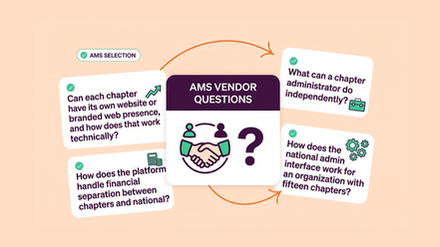
Four questions cut through general vendor assurances. Ask to see the answers demonstrated in a live environment, not described in a slide deck.
Can each chapter have its own branded sub-site on the same platform installation as national? The phrase “same installation” carries the weight here. It is what determines whether member data stays consolidated and whether navigation between sites is seamless. If the vendor hedges on this, press them.
What can a chapter admin manage independently, and what requires national staff involvement? Ask to be shown the chapter admin interface. The answer should be specific: which pages they can edit, which settings sit within their scope, where the permissions boundary lies. Vague assurances about “robust chapter tools” are not an answer.
Is SSO seamless for members moving between national and chapter sites? For sites on the same installation, the expected answer is yes, without qualification. If the vendor starts talking about authentication bridges or additional configuration, that is worth exploring before you sign anything.
Can a chapter spin up a microsite for a conference or campaign without custom development? For associations with active chapter conference programs, this is a practical capability question. It separates platforms built for chapter complexity from those that treat it as an edge case.
The answers to these four questions will tell you more about a platform’s real chapter website capability than any amount of general assurance that chapters are “supported.”