How to manage certification and CPD without adding another system
You probably don’t need an LMS. Here’s what you need instead.
When American Association of Professional Landmen (AAPL) set out to replace six disconnected systems with one, their certification program was the hardest requirement to meet. Ten steps to verify a single sponsor form. Applications managed across paper affidavits and spreadsheets. Four to six weeks from submission to outcome. Most of the platforms they evaluated couldn’t handle it, and they nearly accepted that a separate credentialing tool was just part of the deal. It isn’t, but knowing that requires understanding where a membership platform ends and a learning management system actually begins.
The distinction matters more than it might appear. Learning management systems were built to deliver and track formal learning at scale, typically in education or large enterprise environments. They are powerful tools for organizations running hundreds of courses with sophisticated completion tracking, complex assessment workflows, and detailed learner analytics. For a professional membership body that runs CPD, manages a credentialing program, and provides members with access to recorded events and resources, a full LMS is often more infrastructure than the job requires, and the integration work needed to connect it to your membership data is where the cost and complexity tend to compound.
The MemberWise Digital Excellence 2026 report shows LMS adoption across the membership sector at 21%, up from 18% the cycle before. That growth reflects genuine need in some organizations, but it also reflects a tendency to reach for a specialist tool when the capability already exists, or could exist, within the membership platform itself.
What most associations actually need
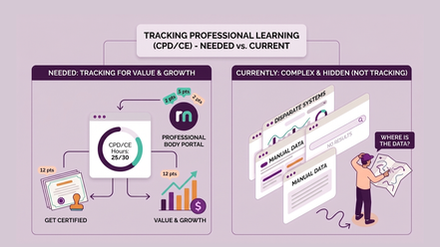
The distinction worth drawing is between delivering learning and managing the professional development lifecycle. Most membership organizations are doing the latter: they need to know which members have accumulated how many CPD points, against what requirements, over what period. They need to issue certificates when thresholds are met, manage applications for credentials, route them through review workflows, and connect the outcome to the member record. They may need to provide access to some courses, but often those courses are hosted elsewhere, and what the AMS needs to do is manage the enrollment, the access, and the credit, not the content delivery itself.
When you break the requirement down this way, the list of things that need to live inside a dedicated LMS gets much shorter. CPD tracking, configurable targets, certificate generation, and credential application workflows are all things a well-built AMS can handle natively, without a separate system, a separate login for members, or the data synchronization challenges that come with connecting two platforms.
What it looks like for a complex credentialing program
AAPL, the American Association of Professional Landmen, runs one of the most complex certification programs in the US association sector. Its three-tier credentialing system covers Registered Landman, Registered Professional Landman, and Certified Professional Landman designations, and involves applications with multi-stage approval workflows, sponsor verification, CPD requirements, examinations through third-party testing providers, and ongoing recertification cycles. Before moving to ReadyMembership, this process was managed across paper affidavits, spreadsheets, and multiple disconnected systems. It was slow, prone to error, and demanding of staff time in ways that could not be recovered.
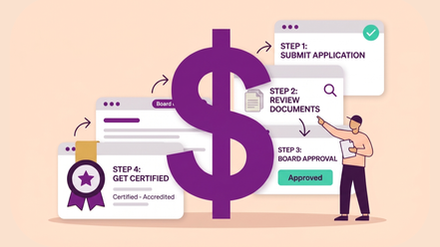
After implementation, the same program runs digitally through the AMS. Candidates apply online through configurable forms, sponsors receive automated verification requests, applications route to committee review without email attachments or manual chasing, and examination eligibility is controlled by the rules engine based on application status and CPD completion. The practical impact was significant: end-to-end certification review, approval, and exam setup went from four to six weeks down to two weeks or less. A process that had previously required ten steps to check a single sponsor form now takes three or four, and for a program handling around 600 applications a year, the cumulative time saving is substantial.
Andrea Spencer, AAPL’s Director of Communications, is direct about what this has meant: “The certification program was our biggest requirement. It’s part of our whole mission. And the pain points were so high with our current system that it was a huge component for us. Most of them couldn’t handle it.”
The point about most platforms not being able to handle it is worth underscoring. Credentialing at this level of complexity is not a standard feature, and AAPL’s decision to make it a non-negotiable requirement during the AMS selection process was the right one. A system that handles your website and your renewals but cannot manage your certification program still leaves you with a separate tool and all the data management that comes with it.
What it looks like for a smaller professional body
PRII, the Public Relations Institute of Ireland, offers a different but equally instructive example. PRII runs a year-round diploma program that includes continuous assessment and end-of-year examinations. A full LMS was not in scope, and it was not needed. ReadyMembership was configured with a custom workflow to manage the academic content and assessment process, sitting alongside the membership, events, and communications the platform already handled. The result was a single system covering everything PRII needed: “We’re part college, part shop, part event organiser,” says CEO Dr Martina Byrne. “That had to be reflected in the build.”
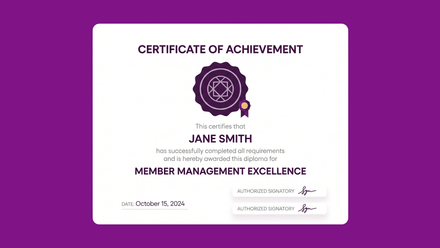
For RIMPA Global, the Australian records management association, the requirement was a CPD dashboard tracking 60 points over a three-year period. Members monitor their progress in real time, log activities against their target, and download a branded certificate of achievement when they reach it, all within the same platform as their events, member directory, and jobs board.
Where a dedicated LMS still makes sense
There are genuine cases where a full LMS is the right answer, and being clear about this matters. If your organization’s primary purpose is delivering a large catalog of formal courses (with video hosting, interactive assessment, SCORM compliance, and learner analytics at course level) then a specialist platform like Brightspace will give you capabilities your AMS should not try to replicate. The right architecture in that case is an AMS with a well-built integration to your LMS: ReadyMembership integrates with Brightspace, passing enrollment data automatically when a member purchases a course, provisioning access via single sign-on, and writing completions back to the member record.
The integration approach means you get the specialist capability where you need it without losing the single view of the member. What you avoid is treating a full LMS as the default answer to any learning-related requirement, including ones that a CPD dashboard, a credential workflow, and a resource library would handle perfectly well.
The self-service dimension
One aspect of CPD management that tends to get underweighted in technology decisions is the member-facing experience. The administrative benefit of tracking CPD in the AMS is clear: it lives on the member record, informs renewal and communications, and feeds into reporting. But the member experience of managing their own CPD matters for engagement too. A self-service CPD dashboard where members can log activities, track progress against their target, and download certificates removes the friction that leads to CPD being left to the last minute or abandoned, and it removes the inbound enquiries to your team that a paper-based or email-managed process generates.
When this sits inside the same portal where members manage their subscription, book events, and access resources, it reinforces the sense that their membership is a coherent whole rather than a collection of separate services delivered through separate systems. That coherence is hard to manufacture with a bolted-on LMS, and considerably easier to deliver when the learning infrastructure is built into the platform from the start.