The three questions associations should answer before investing in AI
There’s a pattern that comes up repeatedly in conversations with associations exploring AI. Leaders have seen the demos, read the headlines, and feel the pressure to act. The question on the table is usually some version of: “How do we get started?”
It’s the right instinct, but it’s often the second question that needs asking, not the first. Before evaluating vendors, comparing tools, or scoping out a pilot project, there are three questions every association should work through. Get these right, and the path forward becomes significantly clearer. Skip them, and even well-resourced AI projects can stall, disappoint, or create problems that are harder to fix than the ones they were meant to solve.
These are questions we return to in almost every conversation with organizations starting their AI journey, because the answers shape everything that follows.
1. What specific problem are you trying to solve?
This sounds obvious, but “we want to use AI” is not a problem statement. It’s a technology preference in search of a use case. The associations that get the most from AI are the ones that start with a clearly defined, genuinely painful problem rather than a vague ambition to modernize.
A useful way to think about this is the concept of loosely versus tightly coupled problems. A loosely coupled problem is one where the AI can deliver value almost immediately, with minimal preparation and few dependencies. Meeting transcription is a good example: the AI receives an audio file, produces a transcript, and you can interact with it, extract action items, and repurpose the content. The value is self-contained. There is no complex web of upstream data or downstream systems that needs to be in place first.
A tightly coupled problem is harder. If the value of your AI depends on pulling context from your CRM, cross-referencing it with your knowledge base, and routing outputs into your member communications workflow, you are building something genuinely complex. That does not mean it is wrong to pursue, but it means the preparatory work is substantial, and the risk of a slow or disappointing rollout is higher.
For associations with small teams and limited technical resource, the practical implication is clear: find the loosely coupled problems first. Where are staff spending time on tasks that are well-defined, repetitive, and information-rich? Drafting responses to recurring member queries, summarizing committee papers, checking documents for consistency: these are the kinds of problems where AI tends to be valuable very quickly. Starting there builds confidence, creates evidence of impact, and teaches the organization how to work with AI before the stakes get higher.
The goal is not to pick the most impressive use case. It’s to pick the one that gets you to value fastest, so you can iterate from a position of knowledge rather than hope.
2. What does your knowledge actually look like?
Many of the most compelling AI applications for associations involve knowledge: giving members faster access to guidance, helping staff find answers without escalating to a subject matter expert, surfacing relevant content at the right moment in the member journey. For any of this to work, the underlying knowledge has to be in reasonable shape.
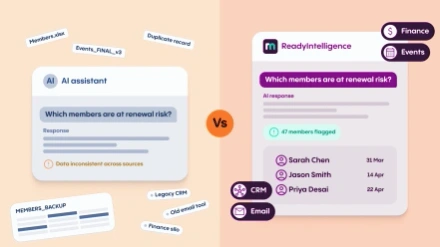
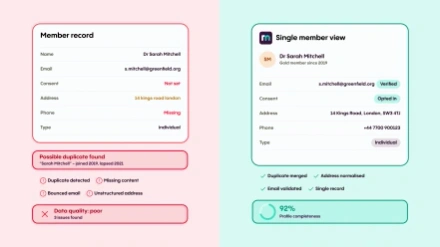
The honest question to ask is not “do we have a knowledge base?” but “what state is it in?” There is a meaningful difference between a content library that is comprehensive, reasonably current, and internally consistent, and one that has accumulated over years without much editorial governance. An AI working from the former can be genuinely impressive. An AI working from the latter will reflect the mess it finds, confidently surfacing outdated guidance, producing contradictory answers, and eroding member trust in the process.
A useful analogy here is the difference between asking a twenty-year veteran of your organization a question, and asking someone who joined last week and has only had access to the shared drive. The junior colleague is not less intelligent; they simply lack the context to know which document supersedes which, or which guidance was quietly withdrawn after a regulatory change. AI has the same limitation. It works with what it can access, and it cannot apply judgment it has not been given.
This does not mean your knowledge needs to be perfect before you start. It means being honest about the gap between where it is and where it needs to be, and factoring that work into your planning. For some organizations, getting the knowledge ready is a bigger project than the AI implementation itself. Knowing that upfront is far better than discovering it six months in.
It is also worth asking whether the knowledge you are working with degrades over time. Static content that is broadly accurate and unlikely to be superseded is a much more tractable starting point than a rapidly evolving regulatory environment where today’s correct answer may be wrong by next quarter. The more volatile the knowledge domain, the more important robust content governance becomes as a precondition for AI.
For a deeper look at how to think about knowledge and data readiness, our AI guide for membership organizations covers the main formats and considerations in detail.
3. Is this an intelligence problem or a knowledge problem?
This is perhaps the most underappreciated distinction in practical AI implementation, and getting it wrong leads to a lot of misplaced effort.
An intelligence problem is one where the value comes from what the AI can reason, analyze, or generate. Proofreading a document. Critiquing an argument. Identifying contradictions in a lengthy report. For these tasks, you provide the input, the AI applies its capability, and the quality of the output depends primarily on how well you have configured and directed it. The knowledge is coming from you in the question itself; the AI brings the analytical horsepower.
A knowledge problem is different. Here, the value you are trying to create depends on the AI having access to the right information from outside the immediate interaction. “Answer my member’s question about the current CPD requirements” is a knowledge problem. The AI is only as useful as the information it can draw on. If that information is incomplete, outdated, or poorly structured, no amount of model sophistication will compensate.
In practice, most meaningful AI applications for associations are a mixture of both. But understanding which element is dominant in any given use case helps you prioritize your preparation. If it is primarily an intelligence problem, invest in how you configure and prompt the system. If it is primarily a knowledge problem, invest in the quality and structure of the information the AI will work from. If you try to paper over a knowledge gap with a more powerful model, you will generally be disappointed.
There is also a risk dimension here. AI is probabilistic, which means it can produce confident-sounding answers that are wrong. For loosely coupled intelligence tasks, where a human is reviewing the output anyway, this is manageable. For knowledge-dependent use cases that feed directly into member-facing responses without review, the consequences of an error are more serious. Building in appropriate human oversight is not a sign of distrust in the technology; it is good practice while your organization develops the experience to know where the boundaries are.
How ReadyIntelligence approaches these questions with clients
The three questions above are ones we work through with organizations before any project begins. They are not just strategic framing; they directly shape what gets built, in what order, and with what safeguards. Rushing past them in the excitement of a new capability is one of the most reliable routes to a disappointing outcome.
What we have found, working with associations across the US, UK and Australia, is that the organizations making the most progress are not necessarily the ones with the biggest budgets or the most ambitious roadmaps. They are the ones who identified a specific, well-defined problem, were honest about the state of their knowledge and data, and built incrementally from early wins.
ReadyIntelligence is designed with this in mind. Rather than giving organizations a blank canvas and asking them to figure out the right thing to build, it provides a structured framework (what we think of as opinionated AI) where the guardrails, data access rules, and use case priorities are informed by what actually works in a membership context. That matters because, as Andrea Spencer at AAPL put it after seeing the AI capabilities within ReadyMembership:
We don't use the word 'transformation' lightly. But that's what it was. It wasn't just a tech project — it redefined how we operate and how we're perceived.