What is membership for in an age of AI?
For decades, a large part of what associations and professional bodies offered their members was access. Access to information, to guidance, to a body of knowledge that was otherwise hard to find or assemble. The newsletter that explained a regulatory change, the library of best-practice guidance, the answer to a technical question that would have taken a member hours to track down. That access was genuinely valuable, and members paid for it.
Artificial intelligence has changed the economics of that access almost overnight. A member with a question about a regulation, a standard, or a process can now get a fluent, immediate answer from a tool that costs them nothing and never closes for the evening. The first draft, the summary, the explanation, the lookup: the things many organizations have quietly relied on as part of their value to members are now abundant and effectively free. It would be a mistake to pretend otherwise, and a bigger mistake to compete with AI on the ground it has already won.
The more useful response is to treat this as a clarifying moment rather than a threat. When the commodity layer of membership falls away, what remains is the part that was always the real value, even if it was sometimes obscured by the convenience of being the place members went for information. The question every membership leader should be asking is not how to defend the old proposition, but what becomes more valuable when answers are free.
What AI makes abundant, and what it cannot
It helps to be precise about what the technology actually does well. AI is very good at producing plausible, well-structured information at scale. It can summarize, explain, draft, translate, and answer general questions quickly and cheaply. For anything that amounts to retrieving and rearranging knowledge that already exists, it is a formidable substitute for a lot of what associations used to provide.
What it does not do is take responsibility, exercise accountable judgment, carry a verifiable professional standing, or belong to a community. Those are not gaps that will close with the next model release, because they are not really technical problems. They are human and institutional functions. And they happen to be exactly the things a membership organization is uniquely placed to provide. As the commodity value of information falls, the value of these things rises, and that is where the future of membership sits.
What AI does not do is take responsibility, exercise accountable judgment, carry a verifiable professional standing, or belong to a community.
Verified expertise becomes a premium signal
When anyone, or any system, can produce confident, professional-sounding output, the ability to prove that a real, qualified human stands behind the work becomes more valuable, not less. In a market flooded with synthetic content and plausible amateurs, a credential that genuinely means something is a premium signal of trust.
This is the work associations have always done, and it is suddenly more important. A professional body that sets a standard, assesses against it, and lets the public verify who has met it is offering something AI cannot manufacture: confidence that a specific, accountable human is who they claim to be and can do what they claim to do. The associations that invest in rigorous credentialing and in making that credential easy to verify will find it is one of the strongest assets they hold, precisely because the surrounding noise has grown louder.
Judgment is the human layer AI cannot replace
AI produces answers. Professionals make judgments. The distinction matters most in exactly the situations members are paid for: the ambiguous case, the high-stakes decision, the moment where the right call depends on context, experience, and an understanding of consequences that a general-purpose model does not have and cannot be held to.
Professional bodies are the institutions that define what good judgment looks like in a field, through standards, codes, and the shared expertise of a community. That role becomes more valuable as the easy answers are automated and the hard ones are left for humans. Members increasingly do not need an association to tell them what the rule is, because AI will. They need an association that helps them exercise judgment about how to apply it, and that vouches for their ability to do so.
Accountability and ethics are functions, not features
When an automated system gets something wrong, there is no one to hold to account in any meaningful sense. A professional who gets something wrong is answerable: to a client, to a regulator where one exists, and to the standards of their profession. That accountability is a large part of what a credential actually buys, and it is something AI structurally cannot provide.
Associations are the keepers of this. The code of conduct, the ethical framework, the route to redress when work causes harm: these are not peripheral member benefits, they are the infrastructure of trust in a profession. As AI takes on more of the routine production, the human commitments around how that work is done, and who answers for it, become the clearer source of value. Many professional bodies already articulate this through the hallmarks of professionalism they hold their members to, and independent judgment and ethical responsibility sit at the center of almost all of them. Those hallmarks read very differently in a world where the mechanical parts of the work can be automated and the human commitments cannot.
The code of conduct, the ethical framework, the route to redress when work causes harm: these are not peripheral member benefits, they are the infrastructure of trust in a profession.
Community is the thing that was never for sale
The final source of value is the one that has nothing to do with information at all. People join professional communities to belong to something, to learn from peers, to find mentors and collaborators, to be part of a shared identity and standard. None of that is something AI provides, and none of it is something a member can get from a tool, however capable.
For many members, especially those who work alone, the association is their professional home: the network that exists outside their own four walls, the people who understand their work, the place their professional identity lives. That value has always been real, but it was easy to undervalue when the information services felt like the headline benefit. With the information now commoditized, community moves from a soft benefit to a central one.
What this means for how associations operate
The strategic implication is not subtle. Associations should stop trying to out-deliver AI on information and lean hard into the things AI cannot touch: credentialing and verification, the standards and judgment that define a profession, the ethical frameworks and accountability that underpin trust, and the community that gives members a professional home. The value proposition is being rebalanced away from access to knowledge and toward proof, judgment, responsibility, and belonging. Organizations that make that shift deliberately will be in a far stronger position than those that keep defending a proposition the technology has already eroded.
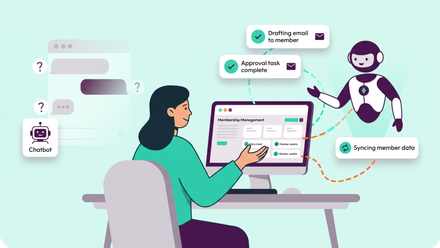
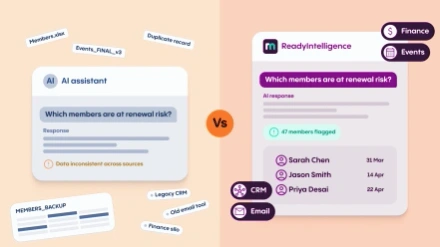
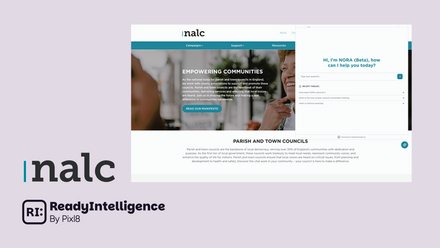
There is also an opportunity in the technology itself. AI is not only a competitor for the old proposition, it is a tool associations can use to deliver more of the new one. Used well, it can take routine administration off staff and members, surface insight from member data that would otherwise sit unused, and free an organization to spend its limited human time on the high-value work of standards, community, and member relationships. At ReadyMembership, this is why we built AI capability into the platform through ReadyIntelligence: not to replace the human value of membership, but to remove the operational drag that stops small teams from delivering it. For an association running on a handful of staff, the difference between drowning in administration and investing in members often comes down to how much of the routine work can be handled for them.
The associations that will matter most in the next decade are not the ones with the best information, because information is no longer scarce. They are the ones that are clearest about what only a human professional community can offer, and most deliberate about building their proposition around it. AI has not made membership less relevant. It has made the real reasons for membership impossible to ignore.