AI in membership: practical use cases beyond the hype
There is no shortage of AI coverage in the membership sector right now. Barely a conference session or industry newsletter goes by without some version of the same promise: AI will transform how you engage members, automate your operations, and unlock the data sitting dormant in your systems. Much of that is genuinely true. But the gap between the broad claims and what associations are actually doing with AI remains wide, and for many membership teams, the conversation has felt more abstract than actionable.
That’s not the conversation we need to have. Instead, this piece looks at where AI can make a concrete difference for membership organizations, what the practical applications look like in day-to-day operations, and what needs to be in place before any of it can work properly.
The shift from assistive to operational AI
Most associations have already encountered AI in its assistive form, whether that is a writing tool used to draft a renewal email, a transcription tool capturing meeting notes, or a generative search tool used to research a policy question. These are individual productivity tools, and they are genuinely useful. But they operate at the level of the individual user, and they leave the underlying operational challenges of membership management largely untouched.
The more significant shift is happening at the platform level, where AI is being embedded into the systems associations use to manage members, deliver content, and run operations. This kind of utility AI works across your organization’s data, does not rely on staff knowing how to write an effective prompt, and delivers value to members directly rather than only to the team member sitting behind a keyboard.
According to the MemberWise Digital Excellence 2026 report, AI adoption across the membership sector has increased by 21% since the previous survey. The primary applications currently are website helper bots and content search, which reflects where the technology is most mature and easiest to deploy. But only a small fraction of organizations are yet delivering AI tools directly to members, and that gap represents both the current state of the sector and the clearest direction of travel.
Making your knowledge findable
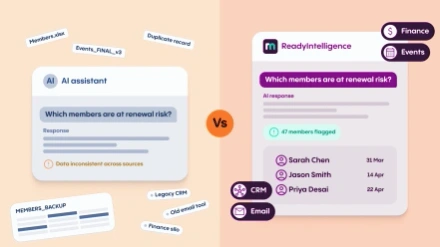
One of the most consistent frustrations in membership management is the volume of staff time consumed by member queries that already have an answer somewhere in the organization’s resources. A member emails to ask about a specific regulation. Another calls to find out whether a particular qualification meets CPD requirements. The answers exist, often documented in detail, but members either cannot find them or cannot find them quickly enough to bother trying. When that happens, some turn to general AI tools instead, which creates a different problem: answers that may sound authoritative but are not grounded in your organization’s verified knowledge.
Rather than matching search terms to document titles, an AI capability embedded in your member portal can understand the intent behind a question, search across all your verified content including PDFs, handbooks, webinars, and training materials, and return a clear, cited answer with links back to the original source.
Members don’t always know the exact terminology they need when searching, so being able to ask a natural question and still be directed to the right source material is incredibly valuable.
For organizations with large, complex knowledge bases, this matters in two directions. Members get faster, more reliable access to specialist guidance, and the organization retains control over how its knowledge is used, rather than seeing members turn to general AI tools that may draw on unverified sources or expose proprietary content. For NALC, whose guidance library includes highly specialized legal and procedural resources not available elsewhere, that protection of intellectual property was central to the decision.
We track a thousand bills right now that are affecting landmen and their jobs. Having members be able to absorb all that, and search it, and find the answers they need, will be really timesaving and helpful.
The distinction from a general AI tool matters here. As Alex Skinner, CEO of Pixl8 Group, has noted, general models can answer broad questions, but they cannot quote your policies, reflect your permissions, or represent your authority. An AI that works from your organization’s own verified content can only return what is actually in it, which is exactly the level of trust that membership organizations need to maintain.
Reducing repetitive query volume
Closely related to findability is the broader challenge of repetitive member support. In many associations, a substantial proportion of inbound queries are variations on the same small set of questions: renewal dates, event details, membership grade requirements, benefit entitlements. Staff answer these questions accurately and professionally, but repeatedly, which is not a good use of anyone’s time or expertise.
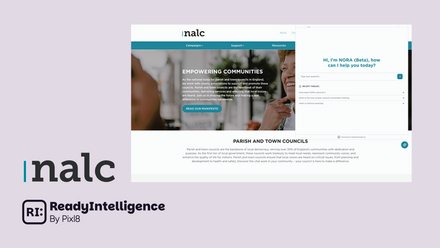
AI-powered self-service changes this not by replacing staff, but by giving members a direct route to verified answers without requiring staff involvement. For NALC, which supports 9,500 users across parish and town councils in England, giving members reliable self-service access was a core part of the case for adopting AI. The organization’s AI assistant, NORA (NALC Online Resource Assistant), is now part of its core membership offering, having completed a trial phase focused on accuracy, usability, and relevance. The organization was also deliberate about making it free to access as part of membership rather than a paid add-on, reflecting the principle that AI should be a shared benefit rather than an additional cost.
The downstream benefit for staff is equally significant. When members can find answers themselves, the volume of routine queries drops, and teams are freed to focus on the work that genuinely requires human judgment and expertise.
Spotting renewal risk before it becomes lapse
Retention analytics have been a feature of association management thinking for some time, but most organizations are still working from relatively blunt instruments: renewal dates, payment status, and perhaps event attendance. The challenge is that these signals are backward-looking. By the time you know a member has lapsed, the window for proactive intervention has usually closed.
Predictive analytics changes the equation by surfacing behavioral signals earlier. An AI capability that draws on your CRM data, portal activity, event bookings, and content engagement can identify patterns associated with disengagement well before a renewal date is missed. A member who has stopped logging in, whose event attendance has dropped off, and who has not opened recent emails may not have told you they are leaving, but the data is already pointing in that direction. Getting that signal weeks or months in advance gives your retention team something concrete to act on.
How do we keep members from falling off? Seeing the trends about forecasting — which of these members are more likely to renew, and why — just seeing that pattern was really compelling.
This kind of early warning system is most valuable for larger membership bodies where manual monitoring is not practical at scale, but it has relevance at any size. The shift is from reactive retention (contacting members after they have lapsed) to proactive engagement while there is still time to make a difference.
Personalization that works from your actual data
Personalized member experience has been an aspiration in the sector for years. In practice, many organizations are still delivering the same homepage, the same email sequence, and the same content recommendations to every member regardless of their role, interests, seniority, or history of engagement. The barriers have typically been data quality and the staff time required to build and maintain complex segmentation rules.
AI-powered personalization addresses both constraints. Rather than requiring your team to define every possible segment and map content to each one manually, an AI capability can analyze role, grade, and engagement history to surface relevant resources, events, and recommendations automatically. As a member’s interests and activity evolve, so do the recommendations, without anyone on the team needing to update a ruleset.
The data also works in the other direction. Analytics that break down website behavior by member type, role, and tenure give content and digital teams a much clearer picture of what different member segments are actually engaging with, informing where to focus content investment and UX improvements. This is a step well beyond what standard website analytics can tell you.
Reporting without the spreadsheet patchwork
Behind many membership operations sits a reporting process that involves exporting data from the AMS, combining it with information from the finance system, cross-referencing with event data, and assembling it all manually in a spreadsheet. This consumes hours of staff time every week, introduces the risk of errors at every handoff, and still produces a picture of the organization as it was last week rather than as it is now.
AI-enabled reporting brings these data sources together into a single, reconciled view that updates automatically. Teams can query their data in plain language rather than waiting for a manually compiled report, and leaders have access to consistent numbers across functions. For finance, membership, and events teams previously working from different versions of the same metrics, the reduction in time spent reconciling data is often one of the most immediately felt benefits.
For the first time, we can easily query all our data — which will help us get to know our 11,000 members even better. It will also make their land research faster, and they’ll get instant access to our extensive archive of articles and webinars — just by asking a question!
What needs to be in place first
None of this works without clean, well-structured data sitting in a connected platform. AI does not fix data quality problems; it amplifies them. If your member records are incomplete, your engagement data is siloed, or your content is scattered across systems that do not talk to each other, an AI capability will reflect those underlying issues back at you. The organizations making the most progress with AI for membership management are those that have invested first in their data foundations: a unified platform where CRM, website, events, and communications data all live together.
The practical starting point for most organizations is not trying to implement every use case simultaneously. It is identifying the one or two operational pain points that cost the most staff time or create the most friction for members, and addressing those first. Findability and self-service tend to be the most accessible entry points because they deliver visible value quickly. Reporting automation often wins over skeptical finance and leadership teams because the time saving is immediate and easy to measure. Renewal prediction requires more data maturity but delivers some of the most strategically significant results once the foundations are solid.
The practical applications available now are already well beyond what most of the sector has implemented, and the organizations that start with a specific problem rather than a broad technology ambition tend to find their footing fastest.