How to segment your membership database for higher email open rates
The instinct when email engagement drops is usually to fix the emails — tweak the subject line, change the send time, try a different template. These things matter at the margins. What tends to matter more is whether the right email is reaching the right person in the first place, and for most membership organizations, the honest answer is that it often isn’t.
The problem isn’t a lack of effort. It’s that most associations are communicating with a genuinely diverse membership (different grades, different career stages, different levels of engagement, different reasons for joining) as though they were a single homogeneous audience. A recently joined student member and a long-standing fellow have fundamentally different relationships with your organization, and a renewal reminder that lands well for one can feel tone-deaf to the other. Email segmentation is the practice of reflecting that diversity in the way you communicate: matching what you send, and when, to where each member actually is.
The challenge is that segmentation often gets treated as a list-building task rather than a strategic discipline. Done well, it requires clarity about what you’re trying to achieve, data that’s accurate enough to act on, and tools that make maintaining segments practical over time rather than just at the point of setup.
Start with the question, not the data
The most common mistake in membership email segmentation is starting with whatever data happens to be available and building segments around it. This produces technically valid but strategically meaningless groups — segments that reflect what the system captures rather than what the organization actually needs to communicate.
The more productive starting point is: what are we trying to achieve with this email, and who does that outcome actually apply to?
Do you want more members? Or are you trying to increase event attendance? There’s no point sending a 20-point questionnaire that overwhelms new members and makes it more difficult to join. Are you going to use that data, do you need it?
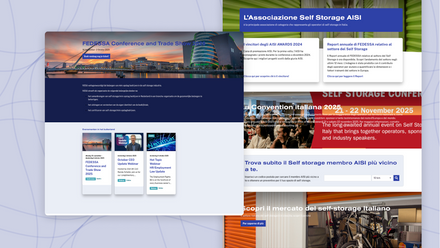
That discipline around purpose is what separates segmentation that improves outcomes from segmentation that adds complexity without benefit. FEDESSA, which represents self-storage associations across Europe, ran bi-weekly polls asking members a single question about industry topics, building detailed preference profiles over time without ever overwhelming members with long-form surveys at the wrong moment. The cumulative picture that emerged gave the team the basis for genuinely targeted communications, and the results were significant: email click-through rates increased by 320%, and member retention rose from 85% to 94%.
The core segmentation layers that matter for membership organizations
Membership email segmentation tends to work across several overlapping dimensions. Most organizations benefit from developing all of them, though you don’t have to tackle everything at once.
Membership status and grade
This is the most fundamental layer. Active members, lapsed members, members approaching renewal, recently joined members, and those on different grade levels all have different needs and different relationships with your organization. An email about the benefits of upgrading makes sense for a certain segment; it makes no sense for a fellow-grade member who has been with you for a decade. Keeping status-based segments current — and automating their maintenance so they update as members move between states — is the foundation everything else builds on.
Engagement behavior
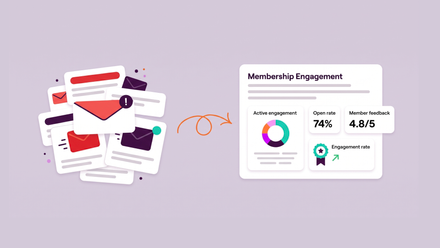
How a member interacts with your emails and your platform tells you a great deal about where they are in their relationship with the organization. Someone who opens every email but never clicks through is reachable but not yet compelled. Someone who hasn’t opened anything in four months may need a re-engagement approach rather than another standard newsletter. Using behavioral data — email opens, clicks, portal logins, resource downloads, event attendance — as a segmentation layer lets you calibrate your communications to match actual engagement levels rather than assumed ones.
Topics of interest and professional focus
Members join professional associations for reasons that are personal to their career stage, role, and area of specialism. A trade body with members across several industry sectors, or a professional association spanning multiple career grades, is in practice communicating with audiences who have very different interests. Where members have expressed those interests — through their joining information, their content interactions, or their event attendance — that signal should inform what they receive. This doesn’t mean every email becomes bespoke; it means that within a single send, the content prioritized for one member reflects what’s relevant to them.
Geography and market
For associations operating across multiple regions or internationally, geography is a segmentation layer that is easy to underutilize. Events, regulations, industry trends, and professional terminology all vary by market. Sending a communication about a region-specific policy development to your entire global membership isn’t just irrelevant — it erodes trust in your ability to communicate relevantly.
Lifecycle stage
Where a member sits in their journey with you — from prospect to new joiner to long-standing member to lapsed — should shape both the content and the tone of every email. Onboarding sequences that help new members get value quickly, renewal workflows that begin well before the deadline and escalate appropriately, and win-back campaigns for lapsed members are all segment-specific communication strategies. The mistake many organizations make is running a single renewal reminder campaign to everyone at the same point in the cycle, when in practice members approaching renewal after ten years of continuous membership are very different from those approaching their first renewal after six months.
Segments should update automatically — not require manual effort
One of the practical barriers to good segmentation is the assumption that maintaining multiple segments requires significant staff time. If building a segment means exporting a list from the CRM, filtering it in a spreadsheet, importing it into your email platform, and repeating that process every time membership status changes, segmentation becomes a burden rather than a tool — and it gets abandoned.
The more effective approach is to define segments as rules rather than static lists, so that membership data continuously populates and updates the segments in the background. A segment defined as “active members who have not logged into the member portal in the last 60 days” doesn’t need to be maintained manually — it should recalculate automatically as member behavior changes. This is the difference between segmentation that works when you first set it up and segmentation that remains useful over time.
In ReadyMembership, this is handled through a combination of dynamic email lists (which automatically add or remove contacts as their data changes) and a segments feature that pre-calculates groups based on defined rules, organized hierarchically so you can see at a glance how many members sit within each segment and how that number shifts over time. This makes it straightforward to build and maintain segments around membership status, engagement behavior, event attendance, group membership, geography, and more, without rebuilding lists manually ahead of each campaign.
Behavioral signals are among your most valuable data
Demographic and status data tells you who a member is. Behavioral data tells you what they actually do, which is often a more useful guide to what they need next.
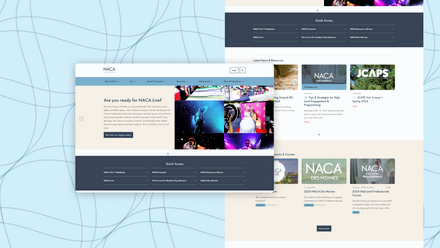
NACA, the National Association of Campus Activities in the US, had very limited visibility into member behavior before moving to a unified platform. Staff couldn’t see which members had logged in, which content they’d accessed, or how they were engaging with communications. Once that visibility became available, the effect on email performance was significant: click-to-open rates rose from 5% to between 25% and 30%, and the email bounce rate dropped from between 14% and 18% to nearly zero.
ReadyMembership has given us powerful tools which will help us and our members succeed.
The improvement reflected not just better deliverability, but the ability to send emails that were relevant to what members were actually doing. Behavioral segmentation is the layer that most organizations take longest to develop, partly because it requires a platform where member activity is tracked in a unified way rather than distributed across separate systems. Where website activity, event bookings, email interactions, and portal logins all live in the same data environment, they can inform a single picture of engagement for each member. Where they’re fragmented across platforms, that picture is incomplete and the segmentation built on it will be too.
Close the loop: what good segmentation looks like in practice
Good segmentation is not a set-and-forget exercise. The value compounds over time when you treat campaign performance as feedback on your segment definitions. If a segment you defined as highly engaged is producing low open rates, that’s a signal to examine whether the segment is accurate, whether the content is well-matched to it, or whether the contact data needs attention.
A useful discipline is to build “reason for sending” transparency into your emails — informing recipients why they’re receiving a particular communication (for example, “You’re receiving this as an active Fellow member”). This reduces spam complaints and builds member trust, but it also functions as a discipline for the sender: if you can’t articulate a clear reason for sending to a segment, that’s worth examining before you send.
FEDESSA’s experience also highlighted a subtler risk: taking segmentation too far. The team found that members were consistently engaging with generic content they hadn’t specifically flagged as an interest area — a useful reminder that personalization and segmentation should enhance relevance, not create filters so narrow that members miss content they’d have valued.
What this means in practice
Membership email segmentation is not a single decision or a single implementation project. It’s a practice that develops over time as data quality improves, as behavioral signals accumulate, and as the team becomes more confident in acting on what the data shows. The associations that get the most from it tend to share a common characteristic: they started with clear communication goals and worked backwards to the segments that made those goals achievable, rather than starting with segments and trying to find goals to match.
The tools that underpin good segmentation: dynamic lists, rules-based filters, behavioral tracking, automated lifecycle workflows, exist to remove the operational friction that otherwise makes this difficult to sustain. But the strategic thinking about who you’re communicating with, and what you actually want them to do, remains something only you can provide.