Why your membership platform needs a rules engine (not just segments)
Most membership platforms can segment. Far fewer can act on it automatically.
Only 19% of membership organizations are using member behavior to drive personalized experiences. It’s worth sitting with that number for a moment. Not because it’s surprising that organizations find this hard, but because the other 81% almost certainly have the data. They know who attended which events, who opened which emails, who renewed late. The problem isn’t the data. It’s that their platform can’t act on it automatically.
That figure comes from the MemberWise Digital Excellence 2026 report, which also shows that 87% of organizations personalize using basic member details and 29% use persona segments. These are useful, but they describe who a member was when they first registered, not what they need right now. The methods that actually reflect what members are doing in real time are still the exception rather than the rule, and the gap between those two things is exactly what a rules engine is designed to close.
For most organizations, this is not a data problem or a strategy problem. It is a platform problem. Segmentation is a classification exercise that puts members into buckets; a rules engine is what turns those classifications into automatic, real-time actions. That distinction determines how much of your personalization strategy you can actually deliver without manual intervention.
What a rules engine actually does
A rules engine is a system that evaluates a set of conditions against your member data and then executes an action when those conditions are met. The conditions can be anything your CRM holds: membership grade, subscription status, location, topics of interest, event attendance history, email engagement, login activity, or any combination of these. The actions can be equally varied, ranging from showing or hiding a piece of website content and triggering an automated email, to granting access to a resource or adding a member to a group.
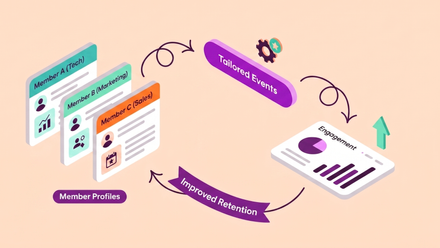
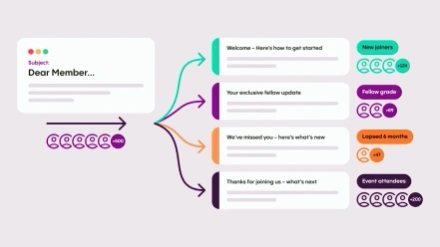
The practical effect is that behavior drives the experience automatically, in real time, without a staff member needing to identify the right segment and manually act on it. A member who attended a webinar on a specific topic can immediately see relevant follow-up resources on their next login. A member approaching their renewal date who hasn’t logged in recently can be automatically enrolled in a re-engagement email sequence. A lapsed member visiting the website can see content specifically designed to draw them back, rather than the same homepage a first-time visitor sees.
None of this requires the complexity people sometimes assume. What it requires is a platform where the rules engine sits inside the same system as your CRM, your website content, and your email tool, so the data, the logic, and the delivery channel are all connected without exports or manual handoffs between systems.
The hidden cost of platforms without one
Most associations running disconnected systems (a CRM in one place, a website in another, an email platform that has to be fed lists from a spreadsheet) have found ways to approximate personalization. They build manual workflows, maintain segment lists that someone updates periodically, and send campaigns to groups they’ve identified by hand. This works after a fashion, but it is fundamentally reactive: it reflects who members were when the data was last updated, not who they are now.
The cost shows up in engagement metrics that plateau, in renewal campaigns that reach the wrong people at the wrong time, and in member-facing experiences that feel generic even when the organization knows enough about its members to do better. It also shows up in the time your team spends doing manually what should happen automatically. As Jennifer Sproul, Chief Executive of IoIC, put it before their digital transformation: “Our HQ team only has 8 people — every week hours of the team’s time were taken up with manual admin and moving data. How could I free up my team’s time and headspace to develop new content and member resources?”
It is a reasonable question for any small association team, and the answer is rarely a better manual process. Every hour spent building and updating segments is an hour not spent on the work that actually requires human judgment.
What it looks like in practice
When Damian Hutt, Executive Director of the Association of Association Executives, first saw a rules engine in a membership platform, his reaction was immediate: “My first memory is looking at the unbelievable personalisation and rules-based system and thinking: we could do even more than we want. You could automate based on all sorts of things.”
That recognition (that the ceiling was higher than the organization had imagined) is common among teams moving from platforms without a rules engine to ones with it. The AAE now sends communications where every email is personalized to the individual recipient, not just segmented by list. “Every email that goes out is personalised,” Hutt explains. It's the same for events, “ Delegates feel that we have nurtured the content and the event for them. And they're able to have more input — because of the ability to gather personalised data from them, which you wouldn't be able to do without the personalisation tools of ReadyMembership."
FEDESSA, the Federation of European Self-Storage Associations, applied similar logic to their renewal program. Rather than relying on a single renewal reminder sent at a fixed point in the calendar, they configured automated personalized reminders and touchpoints throughout the member journey, including renewal benefit reminders sent four months ahead of expiry and timely nudges to late event bookers. The results were measurable: retention increased from 85% to 94%, and 50% of members now renew two months before their renewal date, with email click-through rates up 320%. These outcomes did not come from a new content strategy. They came from the same content reaching the right people at the right time, automatically.
Where most organizations actually are
The MemberWise data on personalization methods is worth returning to here, because it maps neatly to platform capability. Using member details and areas of interest for personalization (which 87% and 47% of organizations do respectively) is well within what most CRM-based platforms can manage, even without a full rules engine. Using online behavior, purchase history, and dynamic persona segments to drive real-time personalization is what requires one.
The 19% using online behavior as a personalization source is not a number that reflects a lack of interest or understanding. Most membership professionals understand conceptually that a member who just attended a conference has different needs in the following week than they did the month before. The constraint is almost always platform capability: either the behavioral data is not being captured in a way the system can act on, or the system lacks the ability to respond to it automatically.
This means there is a meaningful difference between associations that have a platform with a rules engine and those that do not, and it compounds over time. Every interaction a member has with your website, your emails, and your events is a data point that could be shaping the next interaction. Without a rules engine, those signals accumulate unused; with one, they feed directly into the member experience.
How ReadyMembership approaches this
ReadyMembership’s rules engine operates across the whole platform (website content, email marketing, event access, group membership, and member portal) using the same CRM data throughout. Rules can be built on any combination of membership status, location, interests, subscription grade, event attendance, email behavior, portal login activity, or purchase history, and the result is that conditional content, automated communications, and access controls all draw from the same real-time data without requiring exports or manual list management.
This integration is what makes the outcomes described above achievable. FEDESSA’s renewal program runs automatically because the rules engine knows when a member’s renewal date is, what their engagement history looks like, and which communications they have already received. The AAE’s high-frequency event program runs without a dedicated events team because registration, communications, and follow-up are all orchestrated by rules rather than by people.
For organizations that have been personalizing through manual segments and periodic list updates, the shift to rules-based automation is not just an efficiency gain. It is a different model for how your platform works for your members.