How to help members write directory profiles that win work
A member directory can be a genuine source of work for the people listed in it, but only if the profiles inside it are good. Associations invest heavily in building directories and far less in helping members fill them in well, and the result is predictable: a handful of excellent listings, a long tail of thin ones, and a number of members who leave their profile half-finished and then conclude the directory does not work. The Institute of Translation and Interpreting knows this pattern well. A handful of members build rich, compelling profiles, while others leave them thin or incomplete, and some put nothing at all, then wonder why no one finds them.
The good news is that profile quality is one of the most improvable things in any directory, and helping members get it right pays off twice: members win more work and value their membership more, and the directory becomes a stronger asset for the whole organization. This is a practical guide to the support that makes the difference, whether you coach members one to one, run a webinar, or send round a set of tips.
Start with how people actually search
Members tend to write profiles that describe themselves the way they think about their own work. The people searching the directory think differently, in terms of the problem they need solved. The first thing to help members understand is the gap between the two.
Encourage members to picture the person searching and the words that person would use. A client looking for a translator is not searching for elegant prose about a lifelong love of language. They are searching for a specific language pair and a specific field, and they are scanning results for evidence that this person handles exactly their kind of work. ITI structures its directory around this reality, letting users filter by language and by area of specialism. A profile that mirrors those search terms in plain language is far more likely to surface and be chosen.
Make specialisms specific
Vague positioning is the most common weakness in directory profiles. Members worry that narrowing their stated expertise will cost them work, so they describe themselves broadly and end up sounding like everyone else. In practice, the opposite is true: specificity wins. A member who lists a clear specialism is easier to find, easier to trust for that work, and easier to choose.
Help members get granular. The members who use specialism fields well stand out precisely because they look like the obvious choice for a narrow brief. Encourage members to name their actual areas of work, the sectors they know, the document types they handle, the settings they work in, rather than retreating to safe generalities. A profile that says exactly what someone does will beat a profile that tries to say everything.
Fill in every field, and keep it current
Empty fields are invisible to search and unconvincing to a reader. A profile with no specialisms listed will not appear when someone filters by specialism, no matter how skilled the member is. The single most effective piece of advice for many members is simply to complete the profile, every relevant field, before worrying about polish.
It helps to walk members through the fields available and explain what each one does for them. Each field is a way to be found by a different kind of search, so leaving one blank closes off a route to work. Encourage members to treat the profile as a living thing, updated when they take on new kinds of work, gain a qualification, or shift focus, rather than something completed once and forgotten.
Let personality earn attention
Once a profile is findable and specific, a little character helps it convert. A directory listing competes for a reader's attention against others that may be equally qualified, and small human touches make a member memorable. This does not mean turning a professional listing into a personal essay. It means letting a genuine voice come through in the parts of the profile where it fits, so the reader gets a sense of the person they would be working with. A profile that is accurate, specific, and recognizably human will outperform one that is merely correct.
Support members at scale
Few members will improve their profiles on their own, so the association has to make it easy. Practical, repeatable support works best: a short guide, a checklist of fields to complete, a webinar walking through good and weak examples, and an occasional prompt to review and update. The directory is only as strong as the listings inside it, and the association plays a direct role in how strong those listings are.
It also helps to show members the payoff. When members can see that complete, specific, well-written profiles get found and win work, while empty ones do not, the case for spending twenty minutes on a profile makes itself. Sharing directory usage data, or simply relaying member stories about work won through a listing, turns profile completion from a chore into something members want to do.
Where the platform helps
The work of writing a good profile belongs to the member, but the association can make it far easier or far harder depending on how the directory is built. Profiles that are simple to edit, fields that map clearly to how people search, and listings that draw on the member's existing record all lower the barrier to a good profile.
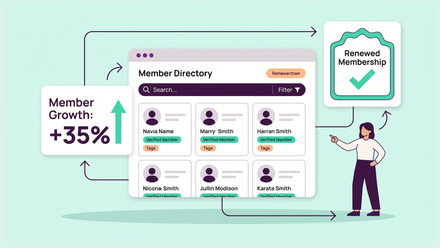
ReadyMembership gives members direct control of their own directory profiles, with structured fields for languages, specialisms, skills, and credentials that connect to the same membership record the association maintains. That means members update their own listings without going through staff, the search reflects the fields members fill in, and the profile stays tied to the member's verified status. The easier the platform makes it to build a strong profile, the more members will, and the more the directory will earn its place as a source of work.