How to give your members a portal they'll actually log into
Low login rates are not a communication problem
The default response to low member portal logins has always been more communication. Another email. A social post. A reminder in the newsletter that the members’ area exists and there are benefits inside. It rarely moves the numbers in any lasting way, and most membership teams know it, but the alternative (rebuilding the portal itself) feels like a larger conversation than anyone has the bandwidth for. The truth is that most portals underperform not because members aren’t interested, but because the portal doesn’t do enough for them to make logging in worth their time.
The MemberWise Digital Excellence 2026 report identifies measuring online member engagement as a top-five priority for membership organizations this year. That is a reasonable priority, but measuring low engagement more carefully does not address the underlying cause. The investment question is whether the portal itself is built to give members a reason to be there.
What members actually need from a portal
The starting point for designing a member portal that gets used is understanding what members need to do, not what the organization wants to communicate. These are different things, and conflating them produces portals that are essentially broadcast channels with a login gate: a wall of content and announcements that do nothing to help members manage their relationship with the organization.
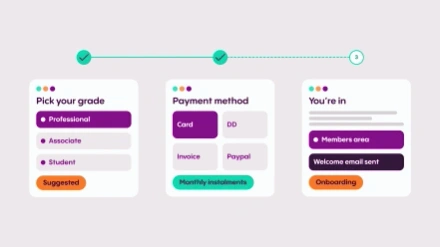
What members reliably need to do (the functional cases that bring them to a portal) includes checking and updating their subscription and payment details, booking and managing event registrations, downloading invoices and certificates, accessing exclusive content or resources, tracking CPD progress, updating their profile and directory visibility, and finding and connecting with other members. These are transactional and self-service needs. They are the things that, when done through a portal, save both the member and the membership team time. When they cannot be done through the portal (when renewing a subscription requires a phone call, or downloading a certificate requires emailing the membership team) the portal fails its primary function.
Beyond the transactional, there is also the question of relevance. A portal that shows every member the same dashboard regardless of their grade, interests, or recent behavior is a missed opportunity to demonstrate that the organization knows who they are. Personalized content (resources, events, and opportunities surfaced based on what the member has expressed interest in or engaged with previously) turns the portal from a notice board into something that actively reflects back the member’s relationship with the organization.
What good login rates look like
PRII, the Public Relations Institute of Ireland, launched their new platform with MyPRII (a member portal built within ReadyMembership) and recorded a 69% first-time login rate in the twelve months following launch. In a member satisfaction survey, 86% of members gave the new platform a positive rating. For context, PRII is a professional body with a core team of five, no dedicated digital resource, and a membership that spans major public sector organizations and independent practitioners. The portal was not built with an unusually large budget or a specialist in-house team. It was built with a platform that made the features members needed available in a coherent, self-service interface.
AMOSSHE, which launched on ReadyMembership in October 2024 serving 908 members across 234 UK higher education institutions, saw 81% of members log in within the first months of launch (a number that Julia Jean-Baptiste, their Communications Manager, described as representing strategic progress the organization had never previously been able to measure). Alongside that adoption rate, 49% of members were actively participating in discussion groups, and the resource library had accumulated over 400 downloads in its top ten resources alone. These are not vanity metrics. They are evidence of a portal that members find worth returning to.
IGEM, the Institution of Gas Engineers and Managers, saw 200 renewals completed online in the first 30 days after launching their new platform. That figure is significant not just as a volume number but as an indicator of changed behavior: members who had previously renewed through other channels chose to do it online, because the online process was straightforward enough to be worth using. That is the test a portal needs to pass, and it is a harder test than it might appear.
Why personalization is load-bearing, not decorative
The shift from a generic member dashboard to a personalized one is sometimes presented as a feature upgrade (a nice-to-have once the basics are in place) but it is worth being clear that it is more foundational than that. A generic portal tells every member the same things. A personalized one tells each member the things relevant to them, based on their grade, their interests, their recent activity, and where they are in their membership lifecycle. That difference in relevance is what determines whether members feel the portal is worth checking.
IoIC, the Institute of Internal Communication, built their member portal (MyIoIC) around a self-assessment tool at the point of joining that captures career history, experience level, and topic preferences. Those preferences then determine the resources, events, and training a member sees when they log in, drawing from a Knowledge Hub built through an audit of over 800 pieces of content. The impact was measurable: 83% increase in website users, 58% increase in member logins, and 25% overall membership growth in the twelve months following launch. Eighty percent of IoIC members now cite the Knowledge Hub as their favorite area of the website, which is a strong signal that the content is reaching the right people rather than being ignored in a list nobody scrolls.
Jennifer Sproul, Chief Executive of IoIC, explained the challenge that the new platform was designed to solve: “Members didn’t feel that IoIC benefits were essential to their daily mission of helping their colleagues and organisations thrive — an emotional disconnect that was a major challenge for us in retaining members, expanding services, and continuing growth.” Personalization was not the only response to that challenge, but it was a significant one. Showing members content that connects to what they are actually trying to do professionally is a more effective argument for the value of membership than any renewal campaign.
The self-service case for operations teams
There is a second constituency for a well-built member portal that often gets less attention in the discussion about member experience: the staff who manage membership operations. Every self-service action a member takes is an inbound inquiry that does not reach the membership team. At NACA, the National Association of Campus Activities, membership renewals that previously required three staff members to process are now handled by one. EAIE eliminated manual mail merges for over 6,000 delegates by giving members self-service tools to download their own invoices, receipts, and attendance certificates. AAPL’s Director of Communications, Andrea Spencer, describes the change in reporting access simply: “When our president calls and asks how many members we have, I don’t have to say ‘let me pull a report’. I can just look up the live number.”
These operational gains are not incidental to the portal investment. They are part of the return on it. A portal that does not enable genuine member self-service pushes every subscription change, every invoice request, and every certificate query back to the membership team, consuming staff time that should be available for the work that actually requires human judgment.
What the integration requirement means in practice
The portals that achieve these outcomes have one thing in common: they are not separate systems bolted onto the organization’s CRM or website. They are built into the same platform, drawing from the same member data, and updating it in real time. When a member changes their subscription grade through the portal, their CRM record reflects that immediately; when they book an event, it appears on their profile; when they download a certificate, the interaction is logged; and when they update their topic interests, the content they see on next login changes accordingly. Each of these sounds simple, and each one breaks when the portal database is separate from the member record.
This integration is what makes self-service reliable enough for members to trust, and what makes the data accurate enough for staff to act on. A portal that requires manual reconciliation between the portal database and the CRM (or that shows members information that does not match what the membership team holds) erodes trust quickly and generates exactly the kind of inbound queries it was supposed to prevent. The technical architecture underneath the member experience is not a detail. It is the reason some portals get used and others do not.