Creating a seamless checkout experience for new members
There’s a particular kind of frustration that most membership professionals have experienced without necessarily naming it: someone visits your website, reads about the benefits, decides they want to join, and then something in the checkout process stops them. Maybe the form feels overwhelming. Maybe their payment method isn’t accepted. Maybe they’re unsure which membership grade applies to them, and there’s no clear guidance. Whatever the reason, they close the tab, and you never know they were there.
The online join journey is one of the highest-stakes moments in the member lifecycle. It’s the point where intention becomes commitment, where a prospective member decides whether your organization is as professional and member-centered as its marketing suggests. Getting it right matters not just for conversion rates, but for the experience a member carries into their first weeks with you.
So what does a genuinely seamless checkout experience look like in practice? And where do most organizations go wrong?
The friction problem
Most join journey problems come down to friction: unnecessary steps, unclear choices, or a mismatch between what the prospective member expects and what they encounter. The consequences are hard to measure precisely because abandoned checkouts leave no trace in your CRM, but they are real.
A common source of friction is the join form itself. Organizations that have spent years gathering member data often treat the join form as an opportunity to capture everything at once: job title, sector, years of experience, areas of interest, communication preferences, and more. The intention is understandable, but the effect can be the opposite of welcoming. As Rennie Schafer, former CEO of FEDESSA, put it when reflecting on his organization’s own join process:
There’s no point sending a 20-point questionnaire that overwhelms new members and makes it more difficult to join. Are you going to use that data, do you need it?
FEDESSA dramatically reduced the number of questions on their join form, focusing only on the information genuinely needed at that stage: industry experience, topics of interest, and technology needs. Rather than front-loading data collection, they built member profiles gradually over time through regular single-question polls. The result was a join process that felt lighter and more respectful of a new member’s time, without sacrificing the data quality they needed to personalize communications and demonstrate value.
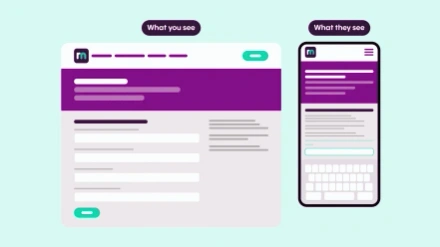
Beyond the form itself, friction can also show up in grade selection that’s confusing or poorly described, limited payment options that exclude certain members, a checkout that isn’t optimized for mobile, or a post-payment experience that feels abrupt and underwhelming. Each of these is a point where someone’s enthusiasm for joining can quietly deflate.
Flexible payment is not optional
One area that receives less attention than it deserves is payment method flexibility. Membership organizations often assume that card payment covers the majority of their audience, and for some that’s true. But the picture is more complex for organizations with diverse membership bases, international members, or institutional memberships where finance teams may need to pay by invoice rather than card.
A prospective member who reaches the payment screen and finds that their preferred method isn’t available faces a simple choice: abandon the process or go through the inconvenience of using a less convenient option. Many will choose the former, particularly if joining is a discretionary act rather than an urgent one.
Supporting multiple payment routes (credit and debit card, direct debit, invoice for larger institutional memberships, and where relevant PayPal or other digital wallets) removes a category of friction that has nothing to do with the quality of your membership offer and everything to do with whether someone can actually complete their purchase. For organizations with international membership, currency flexibility matters too: presenting prices in a member’s local currency, rather than requiring them to do mental arithmetic, reduces cognitive load at exactly the moment when you want the process to feel simple.
It’s also worth considering installment payment plans. Annual subscriptions are standard in the sector, but for some prospective members, particularly early-career professionals or those from lower-income contexts, a monthly payment option can make the difference between joining and not. Offering that choice without forcing members to contact staff to arrange it is a meaningful quality-of-life improvement.
Smart data capture at the right moments
The join form is not the only opportunity to gather information about new members; it’s just the most obvious one. A well-designed join journey thinks carefully about what information is needed immediately, what can wait until a member’s first login, and what is better gathered over time through natural engagement.
One example is communication preferences. If a new member completes their payment but hasn’t been asked which newsletters or updates they want to receive, that creates a problem: you either have to send everything and hope for the best, or wait until their next login to capture the preference. Neither is ideal. There’s a case for including a brief communication preferences step as part of the checkout flow itself, immediately after payment confirmation, when the member’s attention and goodwill are at their highest.
Similarly, the Institute of Internal Communication (IoIC) introduced a self-assessment as part of their join process, capturing information about career stage, experiences, and interests. The purpose wasn’t to create a longer form. It was to ensure that new members join at the right grade and receive relevant resources, events, and training from day one. That’s a different logic from the standard “capture as much as possible” approach: it’s about collecting the right information to deliver immediate value, not just to populate fields in a database.
The principle is restraint in service of relevance. Ask for what you’ll use quickly. Capture the rest progressively, as the relationship develops.
The checkout doesn’t end at payment
One of the most overlooked aspects of the join journey is what happens after a new member completes their payment. For many organizations, the experience effectively ends with a confirmation screen and an automated receipt email, functional, but not particularly welcoming.
That post-payment moment is an opportunity. A new member has just made a financial commitment to your organization. They’re likely to be in a positive state of mind, curious about what comes next, and open to guidance. A well-crafted confirmation email that goes beyond the transactional, explaining what they can access, what to expect in their first weeks, and how to make the most of their membership, can set the tone for a relationship that lasts rather than a subscription that lapses.
What comes after that first email matters too. A new member who receives nothing for two weeks after joining has had their initial enthusiasm quietly drained away. A simple onboarding sequence (a welcome email, an introduction to the members’ area, a prompt to complete their profile) keeps the momentum going and reduces the likelihood of early lapse.
Access to the members’ area should also be immediate on payment completion, not dependent on manual admin intervention. If a new member has to wait to access the benefits they’ve just paid for, that delay undermines the experience regardless of how good the benefits themselves are.
The operational case for getting this right
The argument for a smooth checkout experience is usually made in terms of member satisfaction, and that’s valid. But there’s an equally strong operational argument that’s sometimes overlooked: a well-designed join process reduces staff workload.
The National Association for Campus Activities (NACA) is a useful illustration. Before moving to a unified platform, their renewals process required three staff members. Members who wanted to upgrade their membership had to email the team, who would raise and send invoices and wait for payment. The join journey involved similar manual intervention at multiple points. After streamlining their online join process, renewals that previously required three staff members could be managed by one, and 16 hours per week of admin time was saved through the automated online join process alone.
That kind of efficiency gain isn’t just an operational nicety. For a small team, 16 hours a week is the difference between being reactive and being strategic. It’s time that can go into member engagement, programming, or the hundred other things that create genuine value for members but tend to get crowded out by admin.
Mark Heffner, VP Finance at Colorado League of Charter Schools, captured the financial dimension of this well:
Membership subscription time is always a busy period. This year, I’m excited to see the power and capability of the ReadyMembership system. It will remove the stress of miscalculations and miscommunications, freeing up my time to ensure our members are paying their subscriptions on time.
What a well-designed join journey looks like in practice
Putting this together, a seamless checkout experience for new members has a few consistent characteristics. The join form asks only for what’s needed at that moment, with more detailed information gathered progressively. Grade options are clearly described, with enough context for a prospective member to make a confident choice. Payment methods reflect the likely diversity of the membership base, including installment options where appropriate. VAT and invoicing are handled automatically, without requiring the member to navigate compliance questions they shouldn’t need to think about. Communication preferences are captured at the point of joining, not deferred. And once payment is complete, the experience of becoming a member begins immediately, with clear next steps, instant access, and a welcome sequence that treats a new member as a person rather than a transaction.
ReadyMembership’s join online flow is built around these principles. Organizations can configure each step of the checkout to match their specific membership structure, including multiple grades and pricing plans, subscription add-ons purchased at the point of joining, and application-based routes for grades that require approval. Multiple payment methods are supported out of the box, including card, direct debit, invoice, and PayPal, with the ability to store payment details for future purchases. Post-checkout communications are configurable per pricing plan, and the member’s account area is available immediately on payment completion. For international associations, multi-currency checkout ensures that members in different markets experience a process that feels native rather than approximate.
The join journey also includes a built-in webflow analyzer, which shows where members drop off during the join process, giving teams the data to identify and address specific friction points rather than relying on guesswork.
For organizations with lapsed members, there’s a further consideration: the reinstatement process. A member who has let their membership lapse and then decides to return should face as little friction as possible. Configuring a simple one-page reinstatement window, rather than requiring them to go through the full join process again, acknowledges that they already know your organization and just need a straightforward route back in.
The join journey is one of the few moments where a prospective member’s experience of your platform is entirely unmediated by staff, events, or content. What they encounter there tells them something about how your organization operates and how much it values their time. It’s worth getting right.