Is your member portal the heart of your organisation, or just the login page?
Alison Grundle said it matter-of-factly, explaining why the Global Network of Irish Studies (GNIS) chose ReadyMembership as its platform. The network has no physical offices, no staff beyond a small central team, and no history of doing anything in person. For every researcher who joins from Auckland or Buenos Aires or Cairo or Tokyo, their entire experience of GNIS will be mediated through a member portal. It is the place where the community exists, where work is shared, where researchers find collaborators, where the network’s value is created and felt. In that sense, the portal is not a feature of the organisation so much as the medium through which the organisation expresses itself.
We are using ReadyMembership as the vehicle to build a global network.
That is an unusual situation, and Alison Grundle knows it. But the distance between GNIS and most established membership bodies may be smaller than it first appears. For the vast majority of membership organisations, the portal is already where most meaningful member interactions happen: where people renew, access resources, register for events, update their profiles, and participate in communities. The question is not whether the portal matters. It is whether the organisation has caught up to how much it matters.
How the portal became central without anyone deciding it should be
The elevation of the member portal from administrative convenience to primary member touchpoint happened gradually in most organisations, driven more by member behaviour than by strategic intent. Members shifted online. Expectations about self-service rose. Events went hybrid and then sometimes virtual. Content moved behind a login. Each change nudged a little more of the member relationship into the portal, until for many organisations, a member who never logs in is effectively a member who does not engage with the organisation at all.
This happened fast enough that many organisations have not fully registered it at a strategic level. The portal was built, configured, launched, and then handed to whoever manages the technical side to maintain. Investment decisions continued to be made on the basis of what was always true: that the member relationship was managed through events, through publications, through direct contact with staff. The portal was assumed to support those activities rather than to be, for a growing number of members, the primary way they experience membership.
The practical consequence is that many portals are underbuilt for the role they have been asked to play. They work as login pages and self-service tools. They function as content libraries. But they do not feel like the heart of the organisation, because they were never designed to be.
What a portal looks like when it’s designed to be the centre
There are organisations that have made a different bet. The Institute of Internal Communication rebuilt its digital infrastructure around the conviction that the member portal needed to be the primary place where the value of membership was experienced, not just the place where renewals happened. That meant personalised content based on members’ career stage and interests, a Knowledge Hub that 80% of members cite as their favourite membership benefit, communities structured around specialisms, and a member experience that adapted to individual members rather than presenting the same thing to everyone.
The results were measurable: 52% more member applications, 25% overall membership growth, an 83% increase in website users. But perhaps more telling than the numbers was what Jennifer Sproul, Chief Executive of IoIC, described as the change in what the portal meant to members: it shifted from somewhere they went to manage their subscription to somewhere they went because it was useful to them.
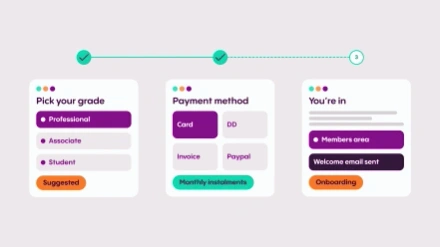
Meat Business Women (MBW) went through a similar transformation. Starting from disconnected systems and a member survey that confirmed members valued the services but struggled to find and access them, MBW rebuilt around a portal designed to be genuinely central to member experience. A directory members actively use to find peers, communities where women across the industry connect and support each other, events that integrate directly with the site rather than requiring members to navigate elsewhere, and an onboarding sequence that orients new members to what the portal offers rather than just confirming their renewal. Approximately 20% of the whole membership logs in every month, a number that reflects members choosing to return rather than logging in only when they have to.
The strategic question the portal forces
For established organisations, the conversation about the portal tends to get stuck at the tactical level: what features are we missing, what is the user experience like on mobile, why are not more people logging in. These are real questions worth addressing, but they are downstream of a strategic one that is harder to sit with.
If most of the value your membership promises is now delivered through the portal, then the portal is effectively your product. How you invest in it, how you prioritise its development, how you measure its performance and respond to what you learn: these are product decisions, and they deserve the same kind of deliberate thinking that goes into decisions about membership benefits, pricing, or programming.
For many organisations, that reframing requires a genuine shift. Portals have historically been thought of as IT infrastructure, something to procure, implement, and maintain. The organisations getting the most from their portals are treating them as membership infrastructure: something to design, develop, and continuously improve based on what members need and what the data shows about how they actually use it.
What GNIS understood from the start
Alison Grundle’s situation at GNIS made this obvious in a way that years of gradual drift can obscure. There was no event calendar full of in-person gatherings. No physical publication landing on desks. No regional staff building relationships face to face. There was a portal and a community, and the portal was the only place the community could exist. Every decision about what features to include, what groups to create, how to make the first login compelling enough that a researcher in New Zealand would decide to come back: every decision was a product decision, because that is what the portal was.
It’s entirely based on what the people who are members put into it. They will determine what it looks like.