How associations handle chapter dues allocation and revenue sharing
Chapter-based associations need their AMS to track dues by chapter, attribute revenue correctly, and feed accurate data into the accounting system. Most platforms claim they do this. The finance team’s experience after go-live is the test of whether they do.
This piece covers four areas. First, the two main dues structures associations use and what each demands from a platform. Second, why financial separation matters regardless of which structure you run. Third, how chapter attribution flows into your accounting system. Fourth, the US-specific tax and integration questions worth raising during evaluation. It closes with the vendor questions that cut through general assurances.
The two main models and what each requires from a platform
The first model is national collection and local distribution. The national association collects dues centrally and distributes a portion to each chapter, typically according to a formula based on chapter membership size or activity. The finance team needs to track revenue by chapter, calculate the distribution, and produce reporting that shows what each chapter is owed. The chapter does not hold the payment relationship with members. National does.
The second model is local collection and national remittance. Chapters collect dues locally and remit a portion up to the national association. The national finance team needs visibility into what each chapter has collected, what they are expected to remit, and whether those remittances are arriving. In this model, the chapter holds the primary payment relationship with its members, which creates a different set of data and reporting requirements.
Many associations operate with elements of both, or with hybrid structures where some membership grades are handled nationally and others locally. The question “how do you handle chapter dues?” has no single answer. An AMS that supports only one model is a constraint. An AMS that technically supports both but makes one of them operationally painful is the same constraint in disguise.
Why financial separation is necessary regardless of the model
Whatever structure an association uses for dues, the finance management requirements share one important feature. Revenue needs to be attributed to the right chapter, tracked separately, and reportable by chapter without manual assembly.
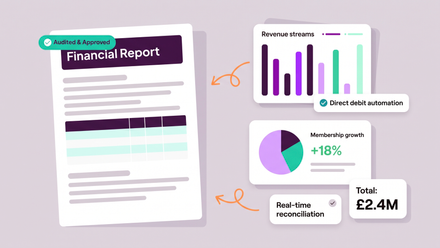
Accounting streams do the substantive work here. The ReadyMembership feature lets you configure separate financial tracks for different parts of the organization. Each chapter can have its own accounting stream with its own invoice numbering sequence, its own invoice templates, and its own tracking categories. When revenue flows through the platform, it is attributed to the correct stream at the point of transaction. Manual annotation after the fact is not required.
The practical implications for the finance team are significant. Revenue by chapter is a single query. Chapter-level reporting does not require exporting data and cross-referencing in a spreadsheet. When a board member asks how chapter membership revenue is trending by region, the answer is one report away.
The audit dimension matters too. When chapter financial records live in separate streams rather than filtered views of a shared ledger, the audit trail is cleaner. For associations where chapters have financial independence, or where board governance requires chapter-level accountability, clean separation is a baseline requirement.
How this connects to your accounting system
For most US associations, platform-level financial tracking is only part of the picture. The data ultimately needs to flow correctly into the accounting system, whether that is QuickBooks, Sage Intacct, NetSuite, or another system the finance team uses for the books.
ReadyMembership’s accounting gateway layer supports bidirectional sync with a wide range of accounting systems, including those widely used in the US nonprofit sector. Invoices, payments, and credit notes sync to the connected accounting system with chapter or stream attribution already in place. The finance team is not manually coding transactions by chapter in their accounting software.
Finance tracking categories add another dimension to transactions. National finance staff can tag revenue with attributes like region or chapter, which can then be reported on within the accounting system. This is useful when the reporting hierarchy in the accounting system does not map exactly to the chapter structure in the AMS.
One honest note. The richer chapter-level financial analytics, including trend reporting, comparative performance by chapter, and multi-period views, tend to happen in the connected accounting software rather than within the AMS admin. The AMS handles the attribution and the sync. The accounting system handles the analysis. That is a reasonable division for finance teams already working in their accounting software daily. It is still worth understanding where each tool’s job ends.
US-specific considerations
For US-based associations, two finance-specific points are worth raising in the context of chapter structure.
The first is state-level sales tax. US associations with chapters across multiple states may have sales tax obligations in every state where they have economic nexus, and the rates and applicability rules vary. ReadyMembership supports dynamic US state-level sales tax configuration. Tax rates can be set per state, and the system applies them automatically based on the purchaser’s billing address at the point of transaction. For a chapter network collecting dues or event fees from members in multiple states, this removes a significant manual compliance burden.
The second is the choice of accounting system. US nonprofits tend to use QuickBooks, Sage Intacct, or NetSuite as their accounting system of record. All three are supported in ReadyMembership’s accounting gateway, with bidirectional sync. If your current platform’s accounting integration does not cover your specific system, or its integration is one-directional and requires manual reconciliation, that is worth exploring during evaluation.
What to ask when evaluating chapter finance capability
When you are evaluating AMS platforms for a chapter-based association, the dues allocation and revenue tracking question deserves the same scrutiny as membership management or event handling. A few questions cut through general assurances.
Can revenue be attributed to individual chapters at the point of transaction, or does attribution require manual tagging afterward? The former is the right answer. Post-hoc manual attribution is where discrepancies and reconciliation errors start.
Can the finance team run a revenue-by-chapter report without an export? Ask for a live demonstration. If the answer involves steps, qualifications, or “you’d use this filter and then cross-reference with this report,” that tells you how the finance team’s day will look.
Does the platform support separate invoice numbering and templates per chapter? For associations where chapters need financial separation for audit or governance purposes, this is a baseline requirement.
Which accounting systems does the platform integrate with, and is the sync bidirectional? One-directional integrations that push data out but do not receive updates back create reconciliation work that lands on the finance team.
What to do next
Chapter finance complexity is not going away. The four areas above set the bar: the dues collection model your association uses, financial separation within the platform, accounting system integration, and US-specific tax and system considerations. An AMS that handles each one cleanly, with attribution at the point of transaction, separated streams for chapter-level reporting, bidirectional accounting sync, and built-in state tax handling, is what keeps the national finance team’s job manageable. The alternative is a recurring exercise in damage control.