Growing chapters without losing control: a guide for national bodies
If your association runs a chapter network and you can’t confidently answer who the members are, what events are running, where the money is flowing, and whether any of it is coming back to the national office, this article is for you. We’ll explain why that gap forms even in well-run networks, what it actually costs you, and what the infrastructure looks like when chapters and national bodies are properly connected. By the end, you’ll have a clear frame for what good chapter oversight looks like — and what to ask for when you’re evaluating a platform that can deliver it.
Chapters are one of the most effective growth mechanisms available to a national association. They build local presence, deepen member engagement, and create the kind of community that makes a membership feel worth renewing. But anyone who has managed a chapter network knows that growth comes with a particular kind of headache, one that tends to get harder to manage the more successful your chapters become.
The problem isn’t that chapters are poorly run. In many cases they’re run by highly committed volunteers who genuinely care about the profession or community they serve. The problem is structural. When chapters operate without a shared platform, a national body starts losing visibility into what is actually happening across its network: who the members are, what events are being held, how dues are being collected, and whether the data that matters is making its way back to the national office at all.
Left unaddressed, that gap grows quietly until it becomes a real risk.
Why chapters drift from national oversight
The typical chapter story goes something like this. A regional group gets established, usually with a small volunteer committee and limited resources. They need to collect event fees quickly, so someone sets up a PayPal account. They want to communicate with local members, so they start a Mailchimp list. They need somewhere to manage registrations, so they pick up a cheap event tool, or start using Wild Apricot because it’s accessible and affordable. None of these decisions are unreasonable in isolation. Collectively, though, they create a parallel infrastructure that sits entirely outside the national organization’s systems.
By the time the national office recognizes the scale of the problem, they may be looking at a dozen chapters each running their own tools, collecting payments through accounts the national organization doesn’t control, holding member data that isn’t captured centrally, and sending communications that may or may not reflect national brand guidelines. In some cases, members who joined through a chapter have never appeared in the national CRM at all.
The data fragmentation is the most obvious symptom, but the risks that come with it go further. Payment compliance, member data protection, and the ability to demonstrate consistent member counts for reporting or accreditation purposes are all affected when chapter data lives outside the national system. For organizations operating across state lines, or internationally, this can become a significant governance issue.
What “losing control” actually costs you
When chapters operate in separate systems, the national office ends up managing the consequences rather than the network. Staff spend time chasing chapter contacts for membership lists, reconciling event revenue that arrived in a PayPal account rather than through the main finance system, or piecing together a picture of chapter engagement from a combination of spreadsheets and email threads.
Beyond the operational drag, there’s a more fundamental problem: the national organization simply doesn’t know what it doesn’t know. Chapters may be running events that aren’t reflected in the national events calendar. Members may have lapsed locally but still appear as current nationally, or vice versa. The chapter chair changes, and the volunteer who was managing the local Mailchimp account takes the login credentials with them when they step down. These are the kinds of gaps that are hard to see until something goes wrong.
There’s also a member experience dimension that’s easy to overlook. Members who engage primarily through a chapter don’t always understand why their experience differs when they interact with the national organization: why they have to log in separately, why their event history isn’t visible, or why they receive communications from both the national office and the chapter that sometimes contradict each other. From the member’s perspective, they joined one organization. The fact that it’s managed across multiple disconnected systems is a problem that belongs to the association, not to them.
Reframing what control actually means
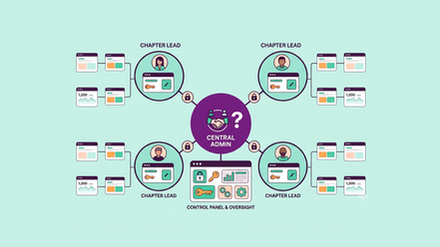
It’s worth being precise about what good chapter oversight looks like, because “control” can be a misleading frame. The goal isn’t to restrict what chapters can do. The most effective chapter networks give local leaders genuine autonomy: the ability to run events, communicate with members, and organize their community without routing every decision through the national office. The goal is to make sure that autonomy happens within a shared infrastructure, so that what chapters do is visible, compliant, and connected to the broader organization.
This distinction matters when you’re thinking about platform architecture. You’re not looking for a system that locks chapters down. You’re looking for one that allows chapter administrators to do everything they need to do locally, while national staff retain visibility into activity, oversight of data, and control over the things that need to be consistent: brand, data standards, financial reporting.
In practice, that looks like chapter leads being able to create and publish events, manage their local member list, and run discussions within their chapter space, while those events flow into the national events calendar, those members exist in the national CRM, and revenue is collected and reported through a single financial system.
Getting the infrastructure right
The transition from “chapters doing their own thing” to “chapters operating within a national platform” is less about persuasion and more about giving chapter volunteers tools that are at least as good as what they were using before, while being genuinely integrated with the national system. A few things need to be in place for this to work.
Member data ownership has to be clear from the start. Every contact who joins through a chapter should exist in the national CRM with a clear relationship to that chapter. The organizational hierarchy (national body, regional chapter, individual member) should be reflected in the data model, not patched in through tags or workarounds. This is what makes it possible to report accurately on chapter membership, identify members who belong to multiple chapters, and maintain a clean national count.
Permissions need to be role-based and granular. Chapter administrators need to be able to do their jobs without needing national staff to action every request. That means having the ability to add and remove group members, publish content within their chapter space, and manage local events, but not to edit national pages, access other chapters’ data, or override financial settings. Getting this right means volunteers feel empowered rather than constrained, and national staff aren’t the bottleneck for every local decision.
Financial flows need to route through national systems. This is often where the most resistance comes from chapter volunteers, because collecting payments through a separate PayPal account feels simpler than using a centralized platform. It’s also where the greatest financial and compliance risk accumulates. A chapter network where dues and event revenue arrive through a unified payment system, tracked against member records and reconcilable by the finance team, is far easier to govern than one where every chapter has its own payment arrangement.
The Colorado League of Charter Schools faced a version of this challenge when they moved to ReadyMembership. Their sector includes intermediate Network organizations, each managing multiple member schools, with a single CFO responsible for receiving and reconciling subscription invoices across all of them. ReadyMembership configured consolidated billing so those contacts could aggregate invoices into one master bill, eliminating the manual reconciliation work that had previously created significant risk during renewal periods.
“Membership subscription time is always a busy period. This year, I’m excited to see the power and capability of the ReadyMembership system. It will remove the stress of miscalculations and miscommunications, freeing up my time to ensure our members are paying their subscriptions on time.”
Mark Heffner, VP Finance, Colorado League of Charter Schools
The structural parallel to a chapter network is direct: when multiple entities sit beneath a national umbrella, the billing infrastructure has to reflect that hierarchy, or the finance team ends up doing the reconciliation work by hand.
Communications should be channel-specific but data-unified. Chapters will often want to send their own communications to local members, and that’s entirely reasonable. What matters is that chapter email activity is visible to the national office, that local lists are drawn from the national CRM rather than maintained separately, and that opt-outs and preferences applied at any level are respected across the whole system. The alternative (separate Mailchimp accounts, separate contact lists, no way to see what a member has received from which part of the organization) creates compliance problems and member frustration in equal measure.
What good looks like in practice
When chapter infrastructure is working properly, the national office gains the kind of visibility that allows it to manage the network proactively rather than reactively. Staff can see which chapters are growing and which are stalling, which events are attracting new members, and which members are engaged across both chapter and national level. That data makes it possible to support struggling chapters with evidence rather than instinct, to reward high-performing ones with additional resources, and to give the board an accurate picture of organizational health.
For chapter volunteers, a well-integrated platform should mean less administrative overhead, not more. Automated group assignment (where members are added to their regional chapter based on location or membership type without anyone having to do it manually) removes one of the most time-consuming tasks from volunteer committee chairs. Shared event tooling means chapter events benefit from the same booking and payment infrastructure as national ones, without the volunteer having to build it themselves.
NACA, the National Association for Campus Activities, is already moving in this direction. Having unified its core membership, events, and communications onto ReadyMembership (saving 16 hours per week on website management, reducing renewals from three staff down to one, and seeing email click-to-open rates rise from 5% to 25–30%), the organization’s next step is to bring its volunteer community onto the platform using the groups function, creating the infrastructure for its network to operate in a connected way rather than through separate tools.
How ReadyMembership supports chapter networks
ReadyMembership is built around a data model that treats organizational hierarchy as a core structure, not an afterthought. National bodies, regional chapters, and individual members can all exist within the same platform with their relationships accurately reflected in the CRM. Parent organizations can hold consolidated subscriptions that cover subsidiary chapters, while chapter-level administrators have the role-based permissions they need to manage their communities without escalating routine tasks to national staff.
The communities and groups module allows national bodies to create dedicated spaces for each chapter, with their own discussion forums, document libraries, event listings, and member directories, all sitting within the national platform rather than outside it. Group membership can be automated using rules based on location, subscription status, or any other CRM data, which means chapter lists stay accurate without requiring manual maintenance.
Financial activity at chapter level flows through the same system as national revenue, giving finance teams a single consolidated view and eliminating the reconciliation work that comes with multiple disconnected payment accounts. And because all member data lives in one place, national staff can report on chapter engagement, membership health, and event performance without having to request exports from chapter volunteers or piece together a picture from multiple sources.
Chapter networks drift from national oversight not because they're badly run, but because the absence of a shared platform pushes well-meaning volunteers toward whatever tools are quickest to set up. That drift is invisible until it isn't — and the costs (data fragmentation, financial and compliance risk, inconsistent member experience, staff time spent reconciling rather than managing) compound the longer it goes on. The fix isn't to clamp down on chapter autonomy; it's to give chapters the local tools they need inside infrastructure the national body controls. When member data, permissions, financial flows, and communications all run through one system, chapter leaders get more capability with less admin, and the national office gets the visibility to support, govern, and grow the network with evidence rather than instinct
For national bodies that have been managing chapter growth through a combination of goodwill and spreadsheets, a unified platform doesn’t just reduce risk. It changes what’s possible to see, and therefore what’s possible to manage well.