Beyond the certificate: getting members to engage with professional development
Almost every professional body asks its members to keep developing their skills, and almost every one struggles to get members to do it consistently, let alone record it. Continuing professional development, whether you call it CPD, continuing education, or simply keeping current, is one of the clearest expressions of what membership stands for. It is also one of the hardest things to make members actually engage with, because the benefit is long-term and abstract while the effort is immediate and easy to postpone. Setting a requirement and hoping members meet it rarely works. What works is making development something members want to do and find easy to log.
The Institute of Translation and Interpreting offers a useful example of getting this right. ITI recommends that members complete a set amount of professional development each year, and built a logging tool into its member platform to track it. What is interesting is not the requirement itself but how ITI turned a compliance task into something members engage with willingly.
Why professional development engagement is so hard
The core difficulty is motivation. Members generally accept that staying current is important, but knowing something matters is not the same as acting on it. Development competes with billable work, family, and everything else, and because the consequences of skipping it are slow to appear, it loses. Associations often respond by tightening requirements, which can produce grudging compliance at best and quiet disengagement at worst.
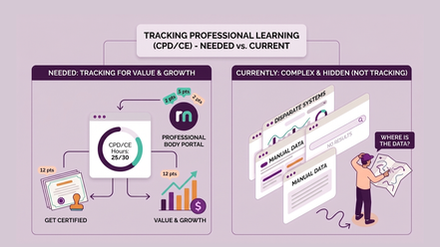
The second difficulty is friction. Even members who do plenty of development frequently fail to log it, because logging is tedious and disconnected from where the activity happens. They attend a webinar in one place, then are expected to record it somewhere else, and the record never gets made. The result is an association that cannot see the development its members are doing, and members who get no credit for it. Both problems, motivation and friction, have to be solved together.
Motivation: make progress visible and a little bit competitive
People respond to seeing their own progress, and to a gentle sense of comparison with peers. ITI leaned into this by gamifying its professional development logging. Members work toward recommended hours shown on a visual dial, earn colored badges for reaching milestones, and get a small celebration when they pass a threshold. It has produced a friendly competitiveness, with some members logging many times the recommended amount and sharing their totals publicly.
The approach works. It turns a requirement most members would meet reluctantly into something a good number actively pursue. The lesson is not that gamification is a gimmick, but that visible progress and light social proof are genuinely effective at shifting behavior, as long as the association stays thoughtful about what it is encouraging.
For organizations worried about rewarding volume over substance, the answer is not to abandon motivation but to shape it: define what counts and review the categories regularly so the framework keeps steering members toward development that matters.
Friction: capture development where it already happens
The most reliable way to improve logging is to remove the logging. When development is recorded automatically as part of the activity, the record gets made every time, without the member having to remember.
ITI does this by connecting its events to its professional development log. When a member books onto an ITI event run through the platform, the relevant development is logged for them automatically. That happens without any manual checking, and members can record development from other sources directly in the log.
Automatic capture also solves the association's visibility problem. When development flows into a central record as it happens, the organization can finally see what its members are doing, which activities are most valued, and where to focus its program.
Give members something they can use
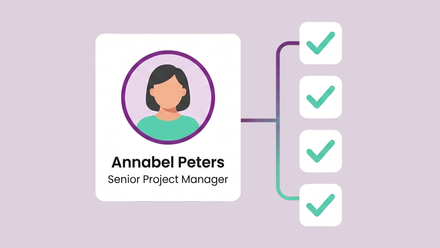
Engagement rises when members get something tangible from their development beyond meeting a requirement. ITI lets members download a certificate confirming their logged hours. The development a member does for the profession becomes something they can point to, which gives them a reason to take it seriously and log it diligently.
This is the shift that makes professional development engagement sustainable. When development is easy to log, visibly tracked, gently encouraged, and useful to the member in their own work, it stops being a box to tick and becomes part of the value of belonging. Members who develop and can prove it are more employable and more committed, and the association gains a clear, current picture of the expertise across its membership.
Where the platform fits
None of this works on disconnected systems. Visible progress needs a live record, automatic capture needs events and development tracking to be part of the same platform, and useful certificates need accurate data behind them. The moment development logging sits apart from events and membership, the friction returns and the record decays.
ReadyMembership brings professional development tracking, events, and membership together in one place, so development can be logged automatically from event attendance, displayed back to members as progress, and drawn on for certificates and reporting, all from a single source of truth. For an organization like ITI, running this with a small team, that integration is what makes an engaging development program manageable rather than a drain on staff time. The motivation and the design are the association's to get right. The platform is what lets those choices scale without creating more work than they are worth.