The hidden cost of running certifications outside your AMS
When associations are reviewing their technology stack and a separate credentialing platform comes up, the conversation usually focuses on the license fee. Is it reasonable for what it does? How does it compare to the alternatives? That is a fair question, but it is only part of the cost picture, and in my experience it is rarely the largest part.
The fuller picture includes what it costs to keep two systems connected, what it costs in staff time to manage the gap between them, and what it costs in missed capability when the certification record and the membership record are not the same record. Those costs are real, they are ongoing, and they tend to be invisible in a budget because they are absorbed into general staff time rather than appearing on an invoice.
The integration overhead nobody budgets for
Running a certification platform separately from your AMS means maintaining a connection between two systems that were not built to work together. In most cases that connection is fragile. Data syncs on a schedule rather than in real time, so what the AMS shows about a member's credential status may not reflect what actually happened this morning. When something breaks — and integrations between separate platforms do break, particularly across version updates — someone has to diagnose it, and that person is usually your most technically capable staff member, whose time has a cost.
Beyond the break-fix overhead, there is the routine reconciliation. Any time the AMS and the certification platform need to agree on something — whether a member's subscription is current, whether they have the right grade to apply, what their CPD balance is — someone has to check both systems and bring the data together. If that is happening at scale, across a large credentialing program with regular review cycles, the accumulated time is significant even when each individual task takes only minutes.
What I find when I work with associations on this is that they often have a sense the integration is creating overhead, but they have not quantified it, because it is distributed across several people's working weeks rather than sitting in one visible cost centre. It tends to only become quantifiable when someone maps it out.
What disconnected data actually prevents
The integration overhead is one side of the cost. The other is what you cannot do when certification data is not connected to your core membership record.
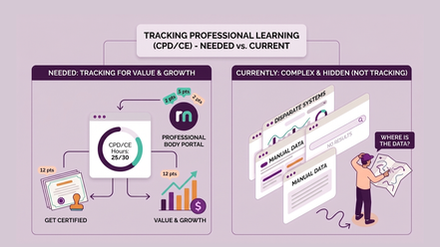
The clearest example is proactive engagement around recertification. When the system can see that a member is approaching a recertification deadline and is behind on their CPD credits, it can flag that and send a targeted communication suggesting relevant events or courses. That is a useful member interaction that also drives event attendance and program engagement. It is only possible when the CPD tracker, the certification record, and the communications platform are all working from the same data. If they are not — if CPD sits in one system and the certification record in another — that kind of proactive, triggered communication requires someone to manually identify the segment, pull the data, and set up the send. In practice it often just does not happen, not because it is not valuable but because it requires more effort than the team has capacity for.
The same applies to benefits access. When a member earns a designation, they should immediately gain access to whatever comes with it — content, directories, community spaces, benefits. If the certification platform and the AMS are separate, the flag that triggers that access change has to cross a system boundary, and unless the integration is set up to handle it cleanly, it frequently does not. A staff member ends up manually updating the member's record in the AMS to reflect what the certification platform recorded. That is a small task, but it happens for every credential awarded, every recertification, every lapse, and across a busy program it accumulates.
What the line-item cost can hide
The license fee for a standalone credentialing platform often looks reasonable in isolation, particularly against the apparent cost of building that functionality into a larger AMS platform. What the line item does not show is the total cost of the setup — the integration build or third-party connector, the ongoing maintenance, the staff time absorbed by reconciliation and data bridging, and the periodic cost of fixing things when the connection breaks.
AAPL, the American Association of Professional Landmen, arrived at ReadyMembership running on six separate systems. The total annual cost of that stack was over $200,000, and as Andrea Spencer, AAPL's Director of Communications, puts it:
It wasn't even working. I mean, it was horrible. We were literally hemorrhaging money to make it work, and it still didn't work.
The certification program was one of the clearest illustrations of the problem. Because the credentialing workflow sat outside the core AMS, there was no automation, no connected data, and no way to manage the process without heavy manual intervention at every stage. When AAPL moved everything onto a single platform, the financial impact was immediate — over $200,000 in annual technology costs eliminated — but the operational impact was arguably more significant. The certification review cycle that had been taking four to six weeks dropped to two weeks or less. The step count for processing a single application fell from 10 to 3 or 4. Staff capacity that had been consumed by manual bridging became available for member-facing work.
The certification program was our biggest requirement. It's part of our whole mission. And the pain points were so high with our current system that it was a huge component for us. Most of them couldn't handle it.
The question worth asking about your own setup
The way I usually frame this for associations who are evaluating whether to keep a standalone credentialing platform or bring it into their AMS is to ask them to estimate the staff time currently spent on tasks that exist solely because the two systems are not the same system. The reconciliation between platforms, the manual access updates, the data exports to bridge a reporting gap, the integration troubleshooting when something breaks. Not the work of running the certification program itself — that work exists regardless — but the work of maintaining the gap.
In most cases, that estimate is higher than people expect. And it does not include the cost of the things that are not getting done because that capacity is absorbed elsewhere: the proactive recertification engagement, the targeted CPD prompts, the real-time reporting that would tell the board something meaningful about credential uptake and renewal rates.
The certification platform's license fee is a real cost and it belongs in the analysis. But it is not the whole analysis, and making a consolidation decision based on it alone tends to leave the most significant costs out of the picture.