Why your member directory is more valuable than you think
Most member directories are a missed opportunity
Why is the member directory usually the least developed feature an association has? It’s not that organizations don’t understand its value. Most membership directors can tell you exactly how a well-built directory should work: faceted search, member-controlled visibility, connected to live CRM data, a genuine reason for members to log in and keep their profile current. They know what good looks like. The directory still tends to be a searchable list of names that someone last cleaned two years ago. The reason is almost always the same: it got built once, at launch, and nobody’s had the case for rebuilding it since.
What most associations have built, though, is a static listing masquerading as a member benefit. A searchable table of names, organizations, and email addresses is not nothing, but it is a long way from what a directory can do when it is built properly into your platform, connected to your member data, and given the structure to be genuinely useful. The gap between a static directory and a well-designed one tends to show up most clearly in the things members do not do: they do not update their profiles, they do not use the directory to find peers, they do not think of it as something worth having. That is not a member engagement problem. It is a product design problem, and the distinction matters because one has a content solution and the other has a platform one.
What makes a directory genuinely useful
The first question worth asking about any member directory is what members are supposed to get from it. For a professional body, the answer might be a way to find practitioners with specific expertise, verify credentials, or identify potential collaborators. For a trade association, it might be a supplier directory that helps members find recommended providers, or a way for members to be found by the organization’s wider audience. For an interest-based network, it might simply be a way for people with shared interests to find each other and feel part of something larger than themselves.
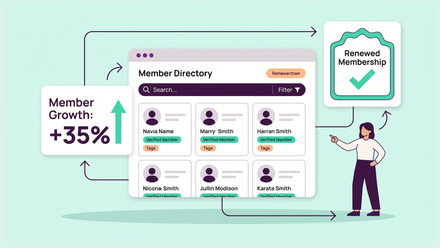
Each of these requires different things from the directory itself. Faceted search (the ability to filter by area of interest, membership grade, location, specialism, or any other attribute held in your CRM) is what transforms a list into a discovery tool. Without it, a directory of more than a few hundred members becomes difficult to use in practice and members stop trying. With it, a member looking for a peer in a specific practice area or region can find what they need in seconds.
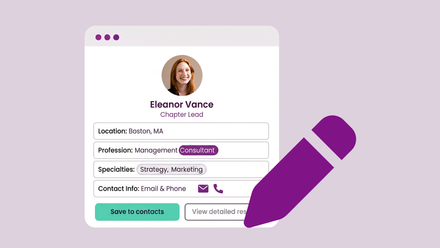
Member-controlled visibility matters for a different reason. Many members are cautious about being searchable, particularly for contact details, and a directory that defaults to full public visibility will see members opting out entirely rather than opting in to limited visibility. Giving members the ability to control what appears in their profile, and to update it themselves without contacting the membership team, keeps the directory current and reduces the friction that leads to profiles being left incomplete or abandoned.
The ITI model: when the directory is the product
For the Institute of Translation and Interpreting, the member directory is not a supporting feature. It is the primary interface between ITI’s members and the world. Translation and interpreting work is largely found through recommendation and searchability, and ITI’s directory allows clients looking for language professionals to search by language pair, specialism, location, and membership grade. For members, being findable through the ITI directory is a direct professional benefit rather than an administrative one, and the quality of the directory’s search functionality directly determines how much value members get from that benefit.
This is an extreme version of the value a directory can hold, but it illustrates the principle clearly. When the directory is built on structured, searchable member data rather than a flat list, it becomes a tool members have a reason to maintain. A translator who keeps their language pairs, specialisms, and contact preferences up to date in their ITI profile is doing so because they know it affects their visibility to potential clients. That incentive keeps the data current in a way that no amount of reminder emails about “please update your profile” can replicate.
The connection between directories and community
AMOSSHE, which serves 908 members across 234 UK higher education institutions, launched their ReadyMembership platform in late 2024. Within months, 81% of members had logged in (a level of adoption that most organizations take years to reach) and 49% were actively collaborating in discussion groups. The directory was part of a broader member portal that gave people genuine reasons to engage, including access to resources, participation in groups, and connection with peers. But the ability to find and connect with other members was an underlying enabler of that activity, not an afterthought.
For the Global Network of Irish Studies, a newly established academic network built specifically to connect researchers internationally, the importance of the directory was explicit from the start. “The only way we can create a global network is through an online portal,” said Alison Grundle, Global Strategy Manager. “There’s just no way we could actually find people and engage in any kind of meaningful communication without it.” For a network that did not yet have the critical mass of face-to-face events or established relationships, the platform’s ability to make members findable to each other was foundational to the organization’s purpose.
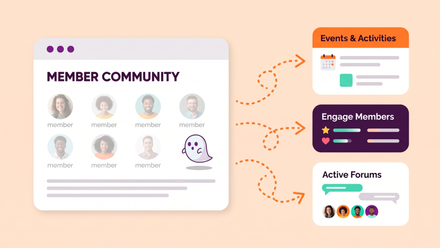
This points to something that static directories cannot address: the relationship between a well-designed directory and a member’s sense that membership connects them to a community. A searchable, profile-rich directory where members can identify peers with relevant expertise and shared interests, and then move into conversation with them through group discussions or direct messaging, creates a different kind of value than a list of names, and the directory is often where that journey starts.
Supplier and specialist directories
For associations with corporate or supplier members, or those that serve members who operate in a supply chain, a directory that distinguishes between individual and organisational members and supports different search criteria for each opens up commercial value as well as member value. RIMPA Global’s platform includes both a member directory and a supplier directory, searchable by area of interest, membership grade, and service or product. Members can find peers; they can also find recommended suppliers in their sector, and suppliers can be found by organisations in the market for their services.
This kind of directory serves multiple audiences simultaneously, which is part of what makes it worth building well. A supplier member who can be found through the directory by potential clients has a tangible reason to value their membership that goes beyond access to content or events. That tangible value is what makes renewal a straightforward decision rather than a negotiation.
The data maintenance problem — and how to solve it
Every association that has tried to maintain a member directory knows the problem: the data degrades. People change jobs, change specialisms, change contact details, and the directory slowly becomes a record of who members were rather than who they are. Fixing this through periodic data cleansing exercises is expensive in staff time and produces results that are already partially out of date by the time they are complete.
The solution is incentive, not administration. When members have a reason to keep their profile current (because it affects their visibility in search results, determines what content they see on login, or controls which groups they are automatically placed in) they update it themselves. A self-service profile that is also the member’s gateway to the platform creates that incentive naturally. When the directory is decoupled from the rest of the member experience, the incentive disappears and the administration burden falls back to the membership team.
Cancer Nurses Society of Australia, which selected ReadyMembership specifically for its ability to segment and personalize across a broad and diverse membership base, identified this connection directly. The ability to match communication and content to what individual members care about relies on having structured, current data about who those members are and what their interests are. A directory that members maintain because it reflects their professional identity back to them is one of the most reliable ways to keep that data accurate.
What to look for in your platform
When evaluating how well your current platform (or a platform you are considering) supports member directories, the questions worth asking go beyond whether a directory exists. Does the search support faceted filtering by the attributes that matter to your members, drawn from your actual CRM data? Can members control their own visibility at a granular level? Does updating a profile in the directory update the member record, or are these maintained separately? Can you run different directories for different audiences (individual members, corporate members, chapter members) with eligibility rules controlling who appears where? And does the directory connect to the rest of the platform, so that finding a peer in the directory can lead naturally to a group discussion, a direct message, or a shared event registration?
The answers to these questions determine whether your directory is a membership benefit or a maintenance burden. Most of the time, the difference comes down to how deeply the feature is integrated with the rest of your platform, and how much of the data maintenance work falls on your team versus your members.