How to use engagement scoring to save your members before they resign
Most membership organizations find out a member is leaving when the renewal notice goes unanswered. By that point, the relationship has already broken down. The member has mentally checked out, probably months earlier, and the renewal reminder is just the administrative confirmation of a decision they made a while ago. The question worth asking is not “how do we improve our renewal process?” but “how do we know which members are drifting before they decide to leave?”
Engagement scoring is one of the most practical answers to that question. It is not a complex concept, and it does not require a sophisticated data science operation to implement. What it requires is a clear-eyed decision about what engagement actually means for your organization, the right data to measure it, and a consistent process for acting on what the data tells you.
This guide covers how to build a basic engagement scoring model, what to do with it once it is working, and the mistakes that tend to undermine it.
What engagement scoring is (and what it isn’t)
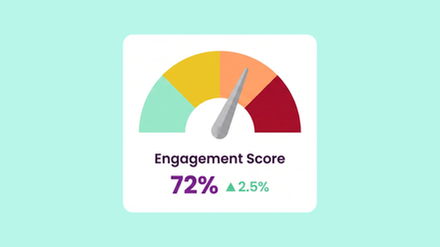
Engagement scoring is a way of assigning a composite value to each member’s level of active participation in your organization, based on their behavior over a defined period. It is not a satisfaction survey, and it is not a measure of how much a member likes you. A member can feel positively disposed toward your organization and still be disengaged, because life has got busy, because they haven’t found a reason to log in recently, or because they joined for one specific benefit and haven’t yet explored the rest of what you offer.
The value of a behavioral model over a self-reported one is that it reflects what members actually do, not what they say they will do or how they describe their relationship with you in a survey. It is also continuous: rather than capturing a snapshot at one point in time, it gives you a live picture that updates as member behavior changes.
The practical goal is to move from managing retention reactively (chasing renewals, responding to cancellations) to managing engagement proactively, so that you are having conversations with at-risk members while there is still something to save.
Choosing what to measure
The starting point is deciding which member behaviors you want to track. This varies by organization, but common examples include event attendance (both booking and actual attendance), portal or website logins, resource downloads, email opens and click-throughs, community or forum participation, training or CPD completions, use of specific member benefits, renewal history, and profile completeness.
The temptation is to measure everything you can. Resist it. Rennie Schafer, former CEO of FEDESSA, put it well when reflecting on his organization’s own data journey: “Do you want more members? Or are you trying to increase event attendance? There’s no point sending a 20-point questionnaire that overwhelms new members and makes it more difficult to join. Are you going to use that data, do you need it?”
The same principle applies to engagement metrics. Start with the behaviors that most reliably predict member value and renewal, and build from there as you gain confidence in the model. Five well-chosen, consistently measured indicators will tell you more than fifteen metrics you can only capture sporadically.
Weighting your metrics
Not all engagement is equal, and your scoring model should reflect that. A member who attends your flagship annual conference is demonstrating a qualitatively different level of commitment than a member who clicked a link in an email, even if both actions technically count as engagement.
Weighting is how you encode that distinction. Active participation should outweigh passive consumption: attending an event, participating in a working group, or submitting a response to a consultation scores higher than opening an email or downloading a resource. High-effort actions matter more than low-effort ones, so a member who completes a CPD module or earns a credential has invested meaningful time and should be weighted accordingly. Recency matters too. An engagement that happened last month is a stronger signal than the same engagement two years ago, and applying a decay function to older activity means the score reflects current behavior rather than historical participation that may no longer be representative. Finally, absence is informative: a member who has not logged in, attended an event, or engaged with any communications in the past six months is telling you something, and zero engagement over a meaningful period should register in the model.
Staffordshire Chambers of Commerce now tracks engagement across approximately 20 member behaviors in ReadyMembership, weighting them according to the level of commitment they represent. Before this system, the team had just three indicators.
Before ReadyMembership, I could only measure engagement against three things: events, room hire, and training. Now I have between 15 and 20 indicators. That stopped me wrongly writing off members who were actually engaged — I just couldn’t see it before.
The consequence of that limited view had been substantial. Before proper engagement data, the team estimated around 50% of members were inactive. The data showed it was closer to 10%.
What to do with the output
Once you have a working model and scores are updating regularly, the question is how to use them. The most effective approach is triage: grouping members by engagement band and applying different levels of attention to each group.
A simple three-band approach works well as a starting point. Members with high engagement are active, participating, and showing up. They do not need proactive outreach to save them, and your time is better spent elsewhere. You can still use this group productively (they are your best candidates for testimonials, referrals, and community leadership roles), but they should not be consuming your membership team’s retention capacity. Members in the middle band are participating at a lower level than you would want, but they are not disengaged. A light-touch check-in, a relevant event recommendation, or a prompt to try a benefit they haven’t yet used may be all that is needed. Members with low or zero engagement are the ones who need your attention, and for this group, proactive personal outreach ahead of their renewal date is where your effort should be concentrated.
Before, I would give the membership team all 1,100 members and say: make sure they’ve all been called twice this year. Now I can say, don’t bother calling that company — they’re clearly engaged. Call this one instead. Their engagement score is zero. They’ve done nothing, attended nothing, booked nothing. That’s who we call.
The result at Staffordshire Chambers has been a 20% saving in membership team time, redeployed into genuinely high-value conversations rather than blanket outreach. More significantly, it has allowed the team to intervene with at-risk members two to three months before renewal, giving them a real window to understand what has changed and respond before it is too late.
We have built a safety net underneath our at-risk members. I can now identify the 30 who have zero engagement, get them in front of me two or three months before their renewal, and give myself a genuine chance of saving them. We have never been able to do that before.

Common mistakes
Over-engineering the model before your data is clean. A sophisticated scoring system built on incomplete or inconsistent data will give you confident-looking numbers that mean very little. Before investing in model complexity, invest in data quality. Make sure your behavioral data is being captured accurately and consistently.
Treating all zero-scorers the same. A member who joined three months ago and hasn’t engaged yet is in a very different position from a member who has been with you for five years and suddenly stopped participating. Tenure matters. New members need onboarding attention; long-standing members with declining scores need a different kind of conversation.
Updating scores infrequently. An engagement score that is only recalculated quarterly is not a retention tool, it is a historical record. For the model to be useful for proactive outreach, scores need to update frequently enough that changes in behavior register in time to act on them.
Using engagement scores in isolation. Engagement scoring is most useful when combined with other signals: renewal history, support ticket volume, survey responses, and direct feedback. A member who scores well on engagement but has submitted three frustrated support requests in the last month may be at greater risk than their engagement score suggests.
Where ReadyMembership fits in
ReadyMembership’s built-in engagement scoring and reporting tools allow membership teams to track behavior across a configurable set of metrics, assign weighted scores, and surface at-risk members automatically. Rather than building a scoring model manually in spreadsheets, teams can work within a single system where the member record, the engagement data, and the communications tools all connect.
For teams starting from scratch, the ability to configure which behaviors to track and how to weight them means the model can be built around what actually matters for your organization, rather than a generic template. And because it updates continuously, it supports the kind of proactive, timely outreach that makes a real difference to retention, rather than a retrospective analysis of members you have already lost.
FEDESSA used a similar approach to lift member retention from 85% to 94%, with 50% of members renewing two months before their renewal date. The transformation came not from a single intervention but from a sustained shift in how the team understood and responded to member behavior, which is, in the end, what engagement scoring makes possible.
Read more about this story