How to give chapter leaders admin access without losing control
The cost of getting it wrong in either direction
Chapter-based associations face two failure modes when granting admin access to chapter leaders. Either chapter leaders cannot act without national staff intervention, or they can act on parts of the system they should never see. Both create real costs: operational drag in the first case, data and governance risk in the second.
The under-access problem is the more visible one. When chapter leaders cannot act independently, national staff absorb the operational load of the whole chapter network. Routine content updates, roster changes, and event setup all queue at national. That is time the national team cannot spend on strategy. The experience for chapter leaders suffers too. Many of them are volunteers giving significant time to the organization, and sitting in a support queue for tasks they feel they should own is a poor return on that commitment.
The over-access problem is quieter but harder to recover from. A chapter president with full admin rights can accidentally edit a national page, view financial data for other chapters, or export a member list outside their scope. This is not hypothetical. It is what happens when access gets granted quickly to solve an immediate problem without thinking through the implications. For associations with data compliance obligations, or where member privacy is taken seriously, the resulting exposure has to be managed deliberately.
The fix is role-based permissions configured tightly enough to give chapter leaders what their role requires and nothing else.
What chapter leaders actually need access to
The starting point for configuring chapter permissions is clarity about what chapter leaders need to do. What they might conceivably want is a separate question. The meaningful self-service capabilities fall into a few categories.
Content management within their site. Creating and editing pages, updating chapter logos and navigation, managing local event listings. These are routine tasks chapter admins should handle without national involvement. A well-configured multi-site architecture gives them exactly that scope: full control inside their site, zero reach outside it.
Roster and contact management. Knowing who sits on the chapter’s organizational membership, updating the finance contact for an organization, and managing who belongs to the chapter group. Tasks like updating which contacts are on a multi-contact organizational membership used to require national admin involvement. In ReadyMembership, those are now front-end self-service capabilities for users with the appropriate access, which meaningfully reduces the day-to-day admin requests landing on national staff.
Group content and communications. Managing documents, discussions, and meeting coordination inside the chapter’s group space. The scope is the chapter’s own group. There is no path for a chapter admin to reach another chapter’s content or the national group structure.
What chapter leaders should not have access to is equally important to define: CRM and finance settings at the national level, other chapters’ data, global site configuration, permission setup for their own sub-site, or any page or setting outside the boundary of their chapter. National staff set those boundaries. National staff hold them, regardless of the chapter leader’s role.
How permissions are configured, and who controls them
One question comes up consistently in chapter permission conversations: who configures the access, national staff or the chapters themselves? In a well-governed setup, the answer is national staff.
National administrators define and assign permission groups. A chapter leader cannot grant themselves additional access, configure their own role permissions, or elevate another chapter member’s access beyond what national has defined. That matters from a governance standpoint. The access model does not drift over time as individual chapter leaders make ad hoc adjustments. National retains real oversight of who can do what across the whole network.
The groups module works slightly differently. National admins define roles inside each chapter group, and those roles get assigned to group members. A chapter chair, a document manager, a discussion moderator: each can hold a role with the specific group permissions that role requires, with no spillover anywhere else in the system. That is the mechanism that makes chapter-level access granular rather than broad.
Scoping volunteer access without inflating it
Named administrative roles handle the chapter president and treasurer cases cleanly. The harder question is what to do with volunteers who need platform access without fitting a formal role.
In ReadyMembership, this is handled through group roles rather than system-level admin roles. A volunteer coordinating an event, or a working group participant who needs to upload documents, can take a role inside the relevant group with permissions scoped to that group. They do not pick up any system-wide admin access. Their ability to act stays inside the group context, and national staff configure what that access includes.
Job roles handle a separate function: identification and targeting. Filtering a contact list by role type, or sending a communication to all event volunteers across chapters, depends on labels applied to contacts. These labels confer no system permissions. They are useful for operational visibility, not access control.
One honest caveat: truly temporary, ad hoc access still requires manual setup and deactivation. A one-off volunteer who needs platform access for a single event will not lose that access automatically when the event is over. There is no automatic expiry. Keeping volunteer access clean over time requires someone at national reviewing and removing access deliberately as roles change.
Managing chapter leadership turnover
Volunteer leadership turnover is one of the more underappreciated operational challenges in a chapter network, and it bears directly on access management.
In ReadyMembership, admin access attaches to a person rather than a title. When a chapter president steps down, the account needs to be deactivated and the incoming president’s account set up with the right permissions. This is a manual process, though with the admin user management improvements in recent platform versions it is a fast one. Creating a new admin account, or adjusting an existing one and assigning the correct permission group, takes a few minutes.
Front-end organization roles allow more flexibility. Admin users can reassign them, and front-end users with the appropriate access can do so too. That allows genuine delegation: chapter leaders with organization-level access can manage the roster of who holds which role inside their organization without national staff handling every change.
The practical implication for national staff is that chapter leadership transitions need to live on the operational radar. Each transition is a trigger to review access, deactivate outgoing accounts, and configure incoming ones. Associations with active chapter networks and regular turnover benefit from a documented process. Treating each handover as a one-off invites drift.
The consolidated view that makes the model manageable
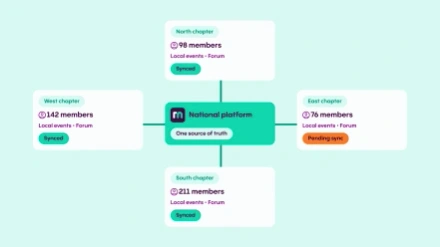
Role-based chapter permissions are worth getting right for two reasons: what chapter leaders can do, and what national staff can see. When chapters operate with scoped access inside the same platform, national staff get a consolidated view of the whole network from a single admin interface. Chapter groups, sites, and events surface in one place, with no logging into separate systems and no chasing chapter volunteers for updates.
Chapter leaders see only their chapter. National staff see everything. That asymmetry is what lets autonomy and oversight coexist, and it makes national oversight real and visible rather than something that depends on chapter volunteers proactively sharing information.
Get the access model right at the setup stage and the investment pays back over time: fewer support requests from chapter leaders, fewer data quality issues from overly broad access, and a clearer view of chapter health for the national team running the network.